Zhangzhou Ancient City vs. Xiamen Zhongshan Road: Which One Is Worth Visiting?
Many foreign tourists visiting Fujian Province have heard of two places: Zhangzhou Ancient City and Xiamen Zhongshan Road. Both are famous historic districts in the Minnan (southern Fujian) region, feature arcaded buildings, and offer a variety of local snacks. However, these two places are actually very different – one is an authentic, living ancient town, while the other is a commercialized tourist pedestrian street. This article provides a detailed comparison to help you choose the destination that best suits your travel style.
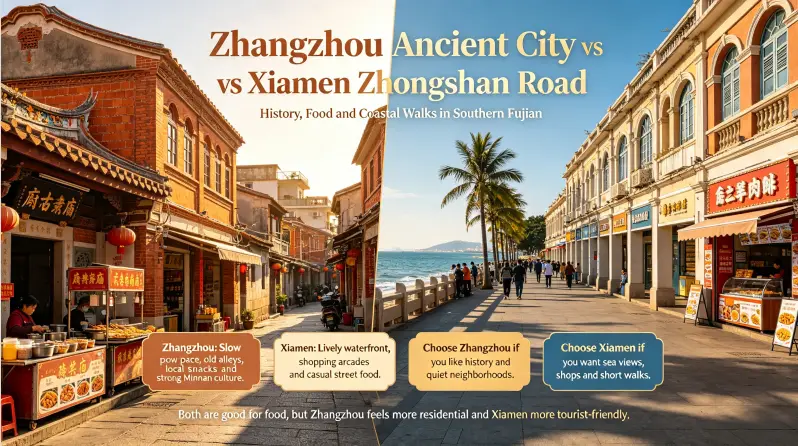
1. Basic Overview
Xiamen Zhongshan Road
- Location: Siming District, Xiamen – right next to the Gulangyu ferry terminal.
- Length: About 1.2 km (0.75 miles).
- History: Built in 1925 (Republican period), named in memory of Dr. Sun Yat‑sen.
- Position: The busiest commercial pedestrian street in Xiamen, a national 4A tourist attraction.
- Visitor type: Primarily domestic and international tourists – massive daily foot traffic.
Zhangzhou Ancient City
- Location: Central Xiangcheng District, Zhangzhou.
- Area: Core area about 1 km² (0.4 sq mi), with multiple streets.
- History: Dating back to the Tang dynasty (prefecture established in 686 AD) – over 1,300 years old.
- Position: A living ancient district, designated as a Chinese Historical and Cultural District.
- Visitor type: Mostly residents and a small number of in‑depth travelers.
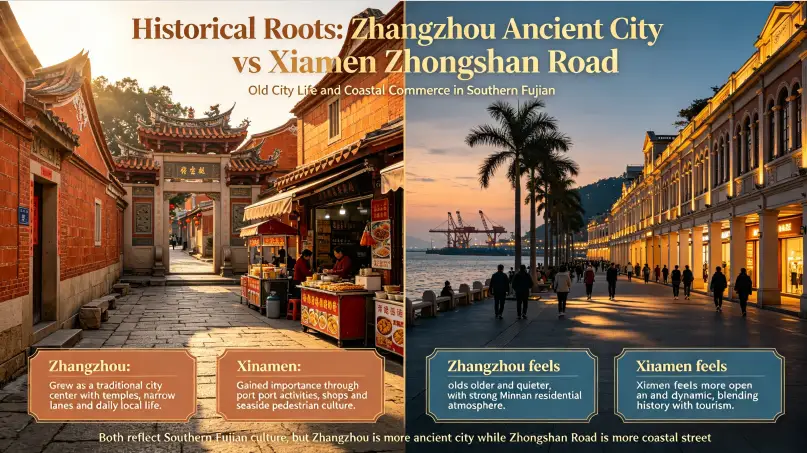
2. Historical Background
Xiamen Zhongshan Road has a history of about 100 years. It was built during Xiamen’s 1920s urban modernization and was the city’s first modern commercial street. Its arcade buildings were modeled after those in Guangzhou and Southeast Asia, reflecting Xiamen’s modern history as a treaty port.
Zhangzhou Ancient City has a history of over 1,300 years. Zhangzhou was established as a prefecture in 686 AD, and the ancient city area was its urban center. The street layout dates from the Tang and Song dynasties, with architectural styles spanning the Ming, Qing, and Republican periods. Many street names have been used for centuries – for example, “Taiwan Road” already existed in the Ming dynasty. Zhangzhou Ancient City is one of the best‑preserved historic districts in Fujian, carrying over a thousand years of Minnan cultural heritage.
In short: Zhongshan Road is a modern commercial street from 100 years ago; Zhangzhou Ancient City is an ancient urban center from over 1,000 years ago.
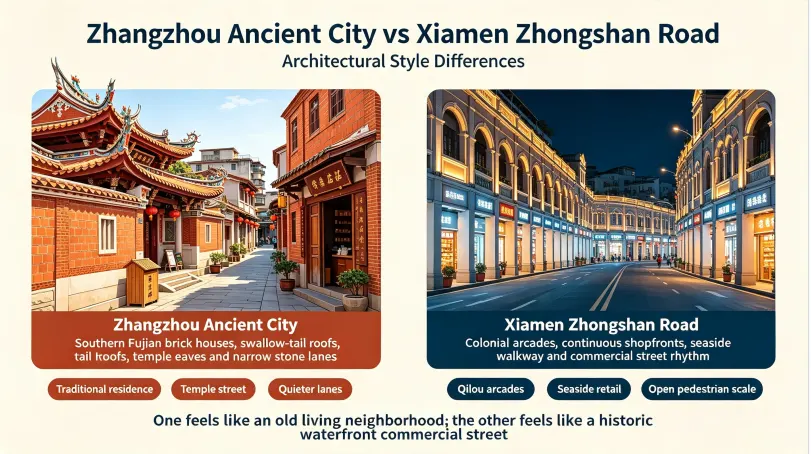
3. Architectural Style
Xiamen Zhongshan Road features arcade buildings – mixed‑use structures with shops on the ground floor and residences above, with a colonnade providing a covered walkway. These arcades were built in the 1920s–1930s, blending traditional Minnan style with Western classical elements (such as Roman columns, arched windows, and pediment decorations). The buildings are uniform and cohesive, symbolizing Xiamen’s modern commercial prosperity.
Zhangzhou Ancient City has much more diverse architecture:
- Tang‑Song street layout: Narrow, winding lanes that preserve the ancient urban fabric.
- Ming‑Qing red‑brick houses: Traditional Minnan residences with red bricks and red tiles, featuring swallow‑tail ridges (curved upward at both ends like a swallow’s tail).
- Republican‑era arcades: Similar to Zhongshan Road but on a smaller scale, preserved on Taiwan Road and Hong Kong Road.
- Ming‑dynasty stone memorial arches: Three well‑preserved stone arches (Shangshu Tanhua Arch, Sanshi Zai’er Arch, and Weixin Liufang Arch) – iconic cultural relics of the ancient city.
In short: Zhongshan Road has a uniform architectural style (Republican arcades); Zhangzhou Ancient City has a diverse mix (Tang‑Song layout + Ming‑Qing houses + Republican arcades + Ming arches).
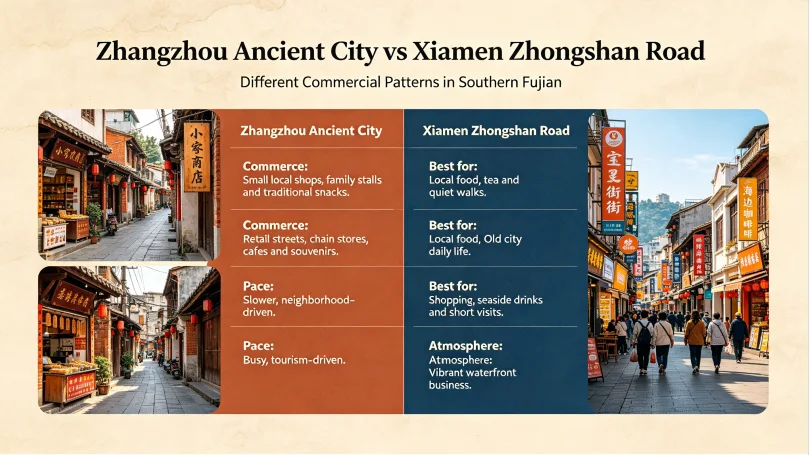
4. Commercial Vibe and Atmosphere
Xiamen Zhongshan Road is a highly commercialized tourist pedestrian street.
- All shops on both sides: brand clothing, jewelry, souvenir shops, specialty stores, chain restaurants, and trendy snack spots.
- Dense crowds, especially during holidays – packed with people.
- Prices are high (tourist‑oriented pricing).
- Open until after 10 PM – has a night‑market atmosphere.
- Feels more like an “outdoor shopping mall” than a historic district.
Zhangzhou Ancient City is an authentic living neighborhood.
- Shops mainly serve residents: grocery stores, tailors, hardware shops, old tea houses, and traditional Chinese medicine shops.
- Few tourists – you can experience real Minnan daily life.
- Prices are affordable (local‑oriented pricing).
- Many shops close by 6 PM; nightlife is concentrated in the night market area.
- Feels more like a “living museum” than a commercial scenic area.
In short: Zhongshan Road is a place for tourists to shop; Zhangzhou Ancient City is a place where locals live.
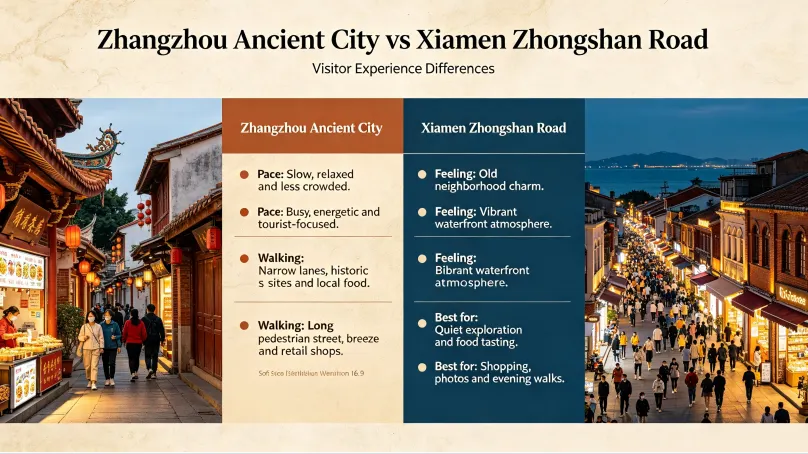
5. Visitor Experience
At Xiamen Zhongshan Road:
- Browse shops and buy souvenirs (e.g., Gulangyu pies, nougat).
- Try trendy snacks (satay noodles, oyster omelets, peanut soup).
- Enjoy the illuminated night view of the arcades.
- You can also walk to the seaside (to the ferry terminal for a view of Gulangyu at night).
- Best for travelers who want shopping, food, and a bustling city atmosphere.
At Zhangzhou Ancient City:
- Stroll along the cobblestone streets and admire architectural details.
- Sit under the old banyan trees, drink tea, and observe local life.
- Visit the Confucian Temple (a Song‑dynasty temple) and the Intangible Cultural Heritage Exhibition Hall.
- Eat at snack shops frequented by locals (at half the price of Zhongshan Road).
- Best for travelers who want to quietly experience history, culture, and authentic life.
In short: Zhongshan Road is lively, fast‑paced, and expensive; Zhangzhou Ancient City is quiet, slow‑paced, and affordable.
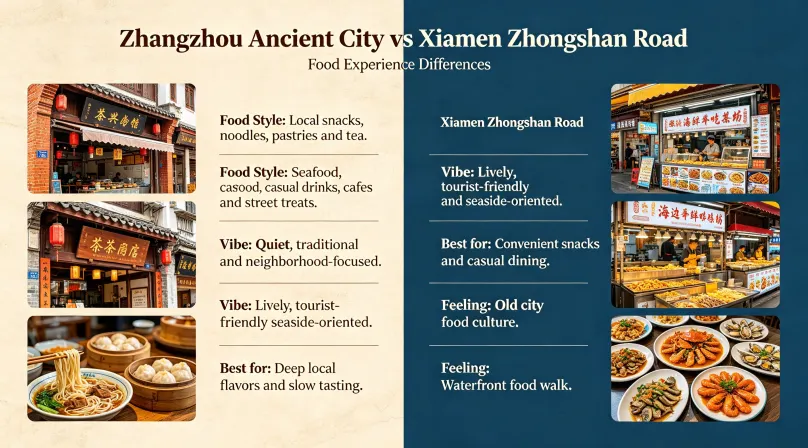
6. Food Experience
Both places offer Minnan snacks, but the experience is completely different.
At Xiamen Zhongshan Road:
- Shops are mostly chain brands or trendy internet‑famous spots.
- Good environment, stylish decor, English menus available.
- Higher prices (satay noodles about 25–35 RMB; oyster omelet about 25 RMB).
- Flavors have been adapted for tourists (lighter, more suited to non‑local tastes).
- Staff can usually speak basic English.
At Zhangzhou Ancient City:
- Shops are mostly decades‑old, family‑run time‑honored establishments.
- A simple, even a bit old‑fashioned environment.
- Affordable prices (braised noodles about 10–15 RMB; satay noodles about 10–20 RMB; four‑fruit soup about 6–10 RMB).
- Flavors are richer and more authentic, preserving traditional recipes.
- Staff mainly speak Minnan and Mandarin – limited English.
In short: At Zhongshan Road, you eat the “tourist version” of Minnan snacks; at Zhangzhou Ancient City, you eat the “local version.” Prices are half, but the flavors are more authentic.
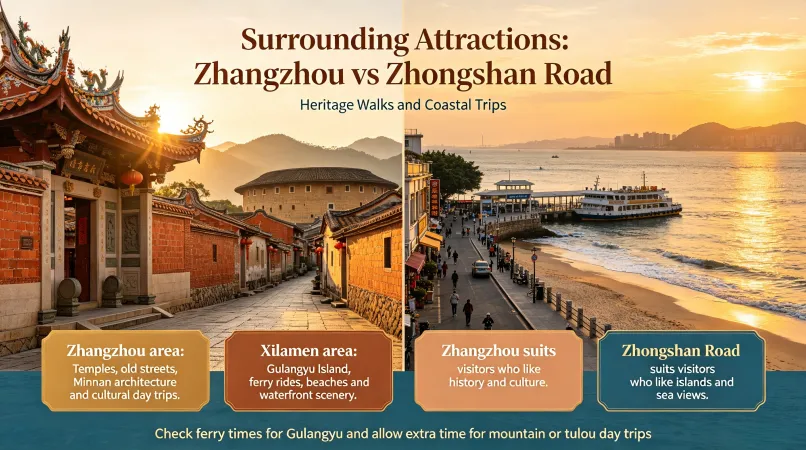
7. Surrounding Attractions
Near Xiamen Zhongshan Road:
- 5‑minute walk to the ferry terminal for Gulangyu.
- 10‑minute walk to the seaside.
- 15 minutes by bus to Xiamen University and Nanputuo Temple.
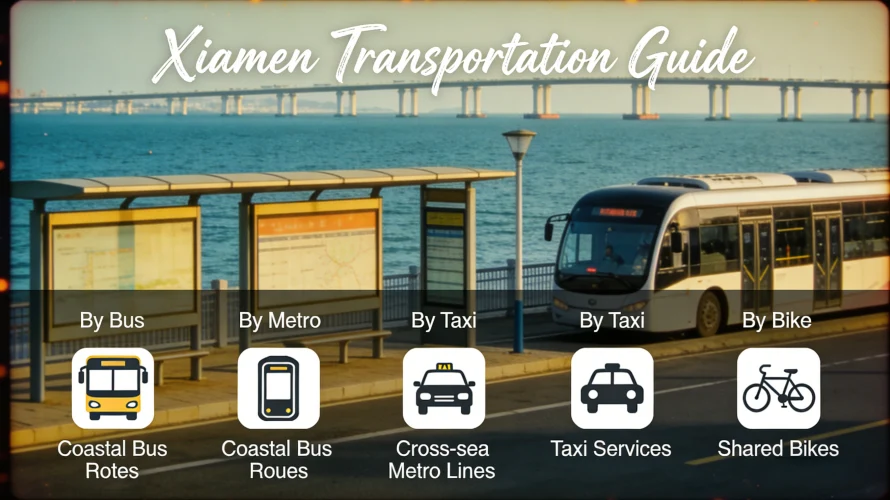
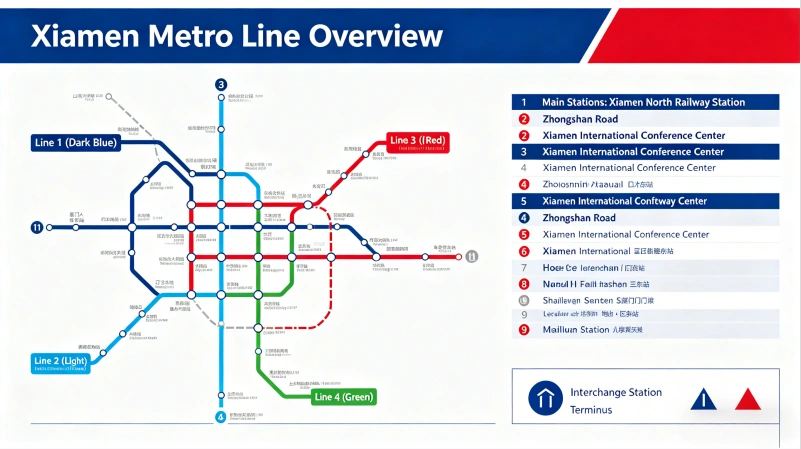
- Metro Line 1 connects directly to Xiamen Station and Xiamen North Station.
Near Zhangzhou Ancient City:
- 15 minutes by taxi to Zhangzhou Station (high‑speed rail).
- 10 minutes by taxi to Nanshan Temple (Tang‑dynasty temple).
- 25 minutes by taxi to Yundongyan (granite scenic area).
- Serves as a transfer hub for Nanjing Tulou, Dongshan Island, and Volcanic Island.
In short: Zhongshan Road is the central hub of Xiamen tourism; Zhangzhou Ancient City is the starting point for Zhangzhou tourism.
8. Which One Should You Visit? Choose Based on Your Travel Preferences
Choose Xiamen Zhongshan Road if you:
- Are visiting Fujian for the first time and have only 1–2 days.
- Enjoy shopping, lively crowds, and urban energy.
- Plan to visit Gulangyu (Zhongshan Road is very close to the ferry).
- Need convenient transport and English‑language services.
- Don’t mind higher prices.
Choose Zhangzhou Ancient City if you:
- Have already been to Xiamen and want to explore a more authentic side of Fujian.
- Are interested in history, architecture, and authentic local life.
- Plan to visit Nanjing Tulou, Dongshan Island, or Volcanic Island.
- Want to save on your travel budget (food and accommodation are cheaper).
- Prefer a quiet, slow‑paced travel experience.
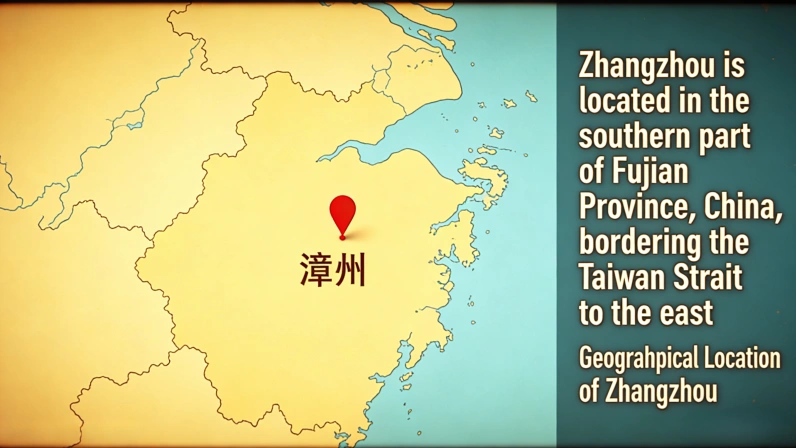
Best plan: If you have enough time (3+ days), visit both. Include Zhongshan Road in your Xiamen itinerary and Zhangzhou Ancient City in your Zhangzhou/Tulou itinerary. The two cities are only 30 minutes apart by high‑speed train – very convenient.
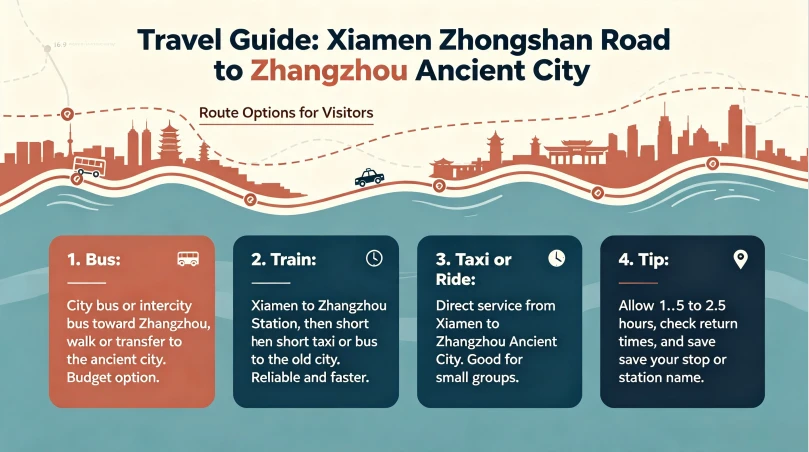
9. How to Get from Xiamen Zhongshan Road to Zhangzhou Ancient City
Getting from Xiamen Zhongshan Road to Zhangzhou Ancient City is very easy:
- Public transport: Walk from Zhongshan Road to Xiamen Station (about 15 minutes), take a bullet train to Zhangzhou Station (about 30 minutes), then take a taxi to Zhangzhou Ancient City (about 15 minutes). Total time about 1.5 hours, total cost about 40–50 RMB.
- Self-drive/private car: From Zhongshan Road, cross the Xiamen–Zhangzhou Bridge to Zhangzhou Ancient City – about 1 hour, covering about 70 km (43 miles).
Frequently Asked Questions (FAQ)
Q: Which is more worth visiting – Zhangzhou Ancient City or Xiamen Zhongshan Road?
A: It depends on your interests. If you want history, culture, and authentic life, choose Zhangzhou Ancient City. If you want shopping, trendy food, and urban energy, choose Xiamen Zhongshan Road. If you have time, visit both – they are only 30 minutes apart by train.
Q: Which is cheaper – Zhangzhou Ancient City or Xiamen Zhongshan Road?
A: Zhangzhou Ancient City is much cheaper. Food prices are about half (braised noodles 10–15 RMB vs. 25–35 RMB), and accommodation is also more affordable. Both have no entrance fees.
Q: Which is better for photography – Zhangzhou Ancient City or Xiamen Zhongshan Road?
A: Zhongshan Road’s arcade nightscape is brightly lit, great for lively urban photos. Zhangzhou Ancient City’s cobblestone streets, red‑brick houses, Ming arches, and old banyan trees are better for historical and atmospheric photos. Different styles – choose based on your preference.
Q: How do I get from Xiamen Zhongshan Road to Zhangzhou Ancient City?
A: Take a bullet train from Xiamen Station to Zhangzhou Station (30 minutes), then a taxi to Zhangzhou Ancient City (15 minutes). Total about 1.5 hours. You can also self‑drive or hire a private car (about 1 hour).
Q: What foods are available at both places?
A: Both have satay noodles, oyster omelets, peanut soup, and other Minnan snacks. However, Zhangzhou Ancient City offers more authentic flavors at lower prices, while Zhongshan Road has better environments and English menus. Zhangzhou Ancient City also has unique dishes not found at Zhongshan Road, such as braised noodles, hand‑grasped noodles, tofu pudding with vermicelli, and four‑fruit soup.
Q: Is Zhangzhou Ancient City older than Xiamen Zhongshan Road?
A: Yes. Zhangzhou Ancient City has over 1,300 years of history (Tang dynasty), while Xiamen Zhongshan Road has about 100 years (built in the 1920s). Zhangzhou Ancient City is one of Fujian’s best‑preserved historic districts and has much higher historical value.
Q: Which is better for families with children and the elderly?
A: Both are suitable, but have different styles. Zhongshan Road is flat, well‑equipped, and convenient for shopping. Zhangzhou Ancient City is also flat (cobblestones – watch for slipperiness), slow‑paced, and affordable. Choose based on your preference.
Related Reading:
- Zhangzhou Tianluokeng: The Iconic Landscape of Fujian Tulou
- Yunshuiyao Ancient Town: Tulou, Banyan Trees & Film Location
- Zhangzhou Volcano Island: Geopark, Pink Maze & Travel Guide
- Zhangzhou Ancient City: A Living Museum of Minnan Culture
- Dongshan Island Travel Guide: Beaches, Attractions & Tips
- Zhangzhou Attractions Guide: Tulou, Dongshan Island, Volcano & Ancient Town
- Zhangzhou Food Guide: Must-Try Dishes & Where to Eat
- Zhangzhou Travel Guide: Tulou, Dongshan Island & Local Food
- 2026 Xiamen Transportation Guide: Metro, Bus, Ferry & Taxi Tips for Foreigners
- Where Is Zhangzhou? 2026 Travel Guide from Xiamen to Tulou & More
- Xiamen Food Recommendations: Top 10 Must-Try Dishes for 2026
- What to eat in zhongshan Road xiamen