Yunshuiyao Ancient Town: Tulou, Banyan Trees & Film Location
Yun Shui Yao: The Ancient Town and Tulou of Fujian
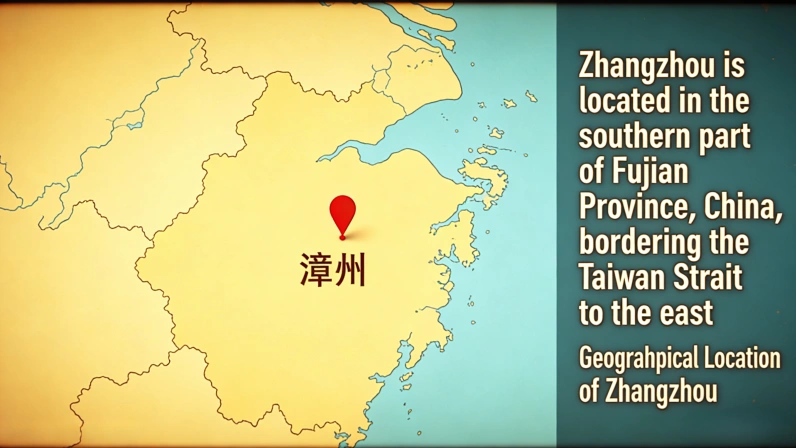
If you are looking for a place in Fujian that combines ancient tulou, a small bridge over a flowing stream, and thousand‑year‑old banyan trees, Yun Shui Yao is the perfect choice. Located in Nanjing County, Zhangzhou City, Fujian Province, Yun Shui Yao was formerly known as “Changjiao Village.” It was renamed after the 2006 movie Yun Shui Yao, which was filmed here. The town has not been overly commercialized and still retains its rustic, rural charm. Its unique scenery consists of a winding stream, a dozen ancient banyan trees, a cobblestone ancient road, and two famous tulou. This guide provides detailed information on what to see, how to get there, ticket prices, and travel tips.

1. Yun Shui Yao Overview
Yun Shui Yao is located in the western part of Nanjing County, about 20 km (12 miles) from the well‑known Tianluokeng Tulou Cluster. The ancient town is built along a small river called Changjiao Creek, with crystal‑clear water and a cobblestone path on both banks. The most striking feature here is the 13 banyan trees that are over a thousand years old. Their huge canopies provide dense shade. Under the trees are stone tables and benches where residents often drink tea, chat, and play cards. The pace of life here is slow, making it an ideal place for travelers who want to relax.
Unlike Tianluokeng, which is a pure tulou cluster, Yun Shui Yao is a combination of “tulou + water town + ancient trees” – a blend of history, culture, and natural scenery.
2. Main Attractions
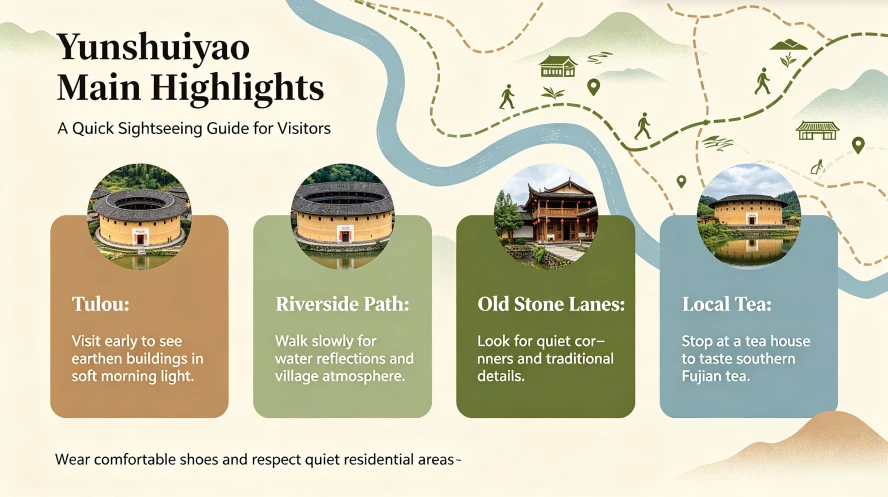
Hegui Lou – Square Tulou Built on a Swamp
Hegui Lou is one of the most famous tulou in Yun Shui Yao. It was built in 1732, nearly 300 years ago. What makes it unique is that it was built on a large swamp. During construction, the builders drove pine piles into the ground (pine resists decay in water), laid a foundation on top of them, and then built this five‑storey square tulou. It is said that if you jump in the central courtyard, the ground beneath your feet slightly trembles – like standing on a trampoline. Yet this tulou has stood firmly for nearly three centuries and is known as the “Noah’s Ark on the Swamp.”
- Highlights: On the ground floor, you can see the exposed pine piles; the cobblestone courtyard floor gives a slight bounce.
- Structure: 5 storeys high, with 28 rooms on each floor. At its peak, about 300 people lived here.
Huaiyuan Lou – The Best‑Preserved Round Tulou
Huaiyuan Lou was built between 1905 and 1909 and is the other famous tulou in Yun Shui Yao. Unlike the square Hegui Lou, Huaiyuan Lou is round, about 38 meters (125 feet) in diameter, and 4 storeys high. It is one of the best‑preserved and most beautifully crafted round tulou in Fujian. The carvings inside, especially the wooden carvings on the gate and the decorations in the ancestral hall, reflect the high level of traditional Minnan architectural art.
- Highlights: The plaque “Si Shi Shi” (This is the Room) in the ancestral hall and the intricate wood carvings. You may also go upstairs for a panoramic view of the circular courtyard (though there may be an extra fee or restrictions due to preservation).
- Note: Huaiyuan Lou is still home to residents. Please keep quiet and respect their daily lives when visiting.
Thousand‑Year‑Old Banyan Trees
The most memorable feature of Yun Shui Yao is the group of 13 ancient banyan trees along the creek. All of these trees are over 1,000 years old. The thickest trunk takes more than ten people holding hands to encircle. Their huge canopies act like giant umbrellas, covering hundreds of square meters. Sitting under the trees in summer is wonderfully cool.
- Best photo spots: Several large banyan trees by the creek, where exposed roots twist and interweave – with the stream, the ancient road, and the tulou in the background, they create a poetic scene.
- Note: The aerial roots (the beard‑like roots hanging down) are beautiful, but please do not climb them.
Yun Shui Yao Ancient Road
The ancient road stretches along Changjiao Creek for about 5 km (3.1 miles), but visitors mainly walk the best section of about 1.5 km (0.9 miles). The path is paved with cobblestones, which have been worn smooth by centuries of walking. On both sides of the road are tulou, village houses, and farm fields. Occasionally, you may see villagers leading oxen past. Walking along this road feels like stepping back into a rural village of a hundred years ago.
The Waterwheel
The movie Yun Shui Yao features a classic scene with a waterwheel. After the filming, the locals built a replica waterwheel by the creek as a memorial to the movie. The waterwheel is about 8 meters (26 feet) in diameter and turns with the flow of the water. It is a popular backdrop for tourist photos.

3. How to Get to Yun Shui Yao
From Xiamen
- High‑speed train + bus: Take a bullet train from Xiamen North Station or Xiamen Station to Nanjing Station (about 40 minutes, fare about 30 RMB). After exiting, take the shuttle bus to Yun Shui Yao (about 1 hour, fare about 20 RMB). This is the most economical public transport option.
- Direct bus: Xiamen Hubin South Bus Station offers direct buses to Yun Shui Yao, but only 1–2 per day. The journey takes about 2.5 hours.
- Private car/day tour: The most convenient option. The drive from Xiamen to Yun Shui Yao takes about 2.5 hours. Private car rental costs about 400–600 RMB per day (including driver). You can also join a day tour.
From Zhangzhou city
- Bus + transfer: Take a bus from Zhangzhou Bus Center to Nanjing county town, then transfer to a local bus to Yun Shui Yao. Or hire a private car – about 1.5 hours.
Getting around Yun Shui Yao
- The ancient town is compact. All major attractions are within walking distance. No internal transport is needed.

4. Ticket Information
- Yun Shui Yao entrance ticket: About 90 RMB (includes Hegui Lou, Huaiyuan Lou, and the ancient road).
- Discounts: Students, seniors, and children get half-price admission with a valid ID.
- Opening hours: 8:00 – 18:00.

5. Best Time to Visit
- Spring (March–May): Warm weather, full creek, fresh greenery on the ancient trees – the best season.
- Autumn (September–November): Cool weather, soft sunlight – great for hiking.
- Summer (June–August): Hot and rainy, but very cool under the banyan trees. Watch for typhoons and heavy rain.
- Winter (December–February): Mild with little rain, fewer tourists, but chilly in the mornings and evenings – bring a jacket.
- Best time of day: Early morning (7:00–9:00) and late afternoon (16:00–18:00) – soft light, fewer tourists, and good for photography.

6. Food Recommendations
Restaurants in Yun Shui Yao serve Hakka and Minnan farmhouse cuisine at reasonable prices.
- Hakka stuffed tofu: Tofu filled with minced meat, pan‑fried until golden, then braised – delicious.
- Pork with preserved mustard greens (Meicai Kou Rou): Pork belly steamed with preserved mustard greens – not greasy and very satisfying with rice.
- Creek fish: Small fish from Changjiao Creek – deep‑fried or in soup, very fresh and sweet.
- Bamboo tube rice: Rice with cured meat and mushrooms packed into bamboo tubes and roasted – fragrant with bamboo aroma.
- Tulou rice wine: Locally brewed rice wine – low alcohol, sweet and sticky.
Cost per person: About 40–60 RMB.
Recommended restaurants: “Yun Shui Yao Restaurant” and “Riverside Home” inside the ancient town – good atmosphere and fair prices.

7. Suggested Itineraries for Yun Shui Yao
One‑Day Trip (Round trip from Xiamen)
- 7:30 AM – Depart from Xiamen (private car or day tour), arrive at Yun Shui Yao around 10:00 AM.
- 10:00–11:30 – Visit Hegui Lou (swamp tulou) and Huaiyuan Lou (round tulou).
- 11:30–12:30 – Lunch – taste Hakka dishes.
- 12:30–15:00 – Walk along the Yun Shui Yao Ancient Road, enjoy the thousand‑year‑old banyan trees, the waterwheel, and the creek scenery.
- 15:00–16:00 – Rest and have tea at a teahouse under the banyan trees.
- 16:00 – Return to Xiamen; arrive around 18:30.
Two‑Day Trip (Combine with Tianluokeng)
- Day 1: Depart from Xiamen in the morning. First visit Tianluokeng “Four Dishes and One Soup” + Yuchang Lou. In the afternoon, go to Yun Shui Yao and stay overnight in a guesthouse.
- Day 2: Morning – visit Hegui Lou, Huaiyuan Lou, and the ancient road. Return in the afternoon.
8. 住宿建议
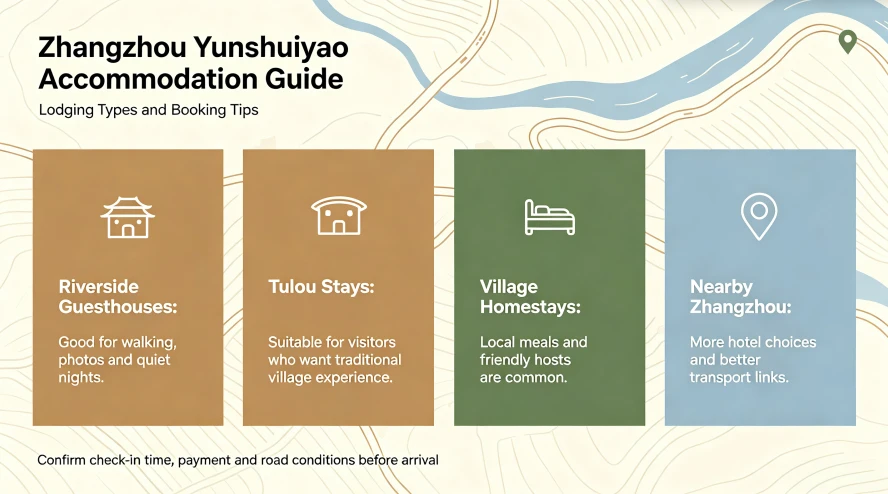
There are many guesthouses in Yun Shui Yao, mostly converted from old houses, retaining the tulou and village style.
- Tulou guesthouses: Such as “Hegui Lou Guesthouse” and “Huaiyuan Lou Inn” – stay inside the tulou for an authentic experience. Price: about 200–400 RMB/night.
- Riverside boutique guesthouses: Built along the creek with balconies for scenic views. Price: about 300–600 RMB/night.
- Recommended booking platforms: Trip.com, Agoda, Booking.com. Book at least a week in advance, especially during holidays.
9. Practical Travel Tips
- Clothing: The ancient road is paved with cobblestones – not very smooth. Wear comfortable sports shoes or hiking shoes. No high heels or flip‑flops.
- Insects: Mosquitoes are common near the creek and under the trees – bring insect repellent.
- Weather: The mountain weather in Nanjing County can change quickly – bring an umbrella or raincoat.
- Language: Locals mainly speak Hakka and Minnan, but shop and guesthouse owners can speak Mandarin. Use a translation app.
- Payment: Most shops accept WeChat Pay and Alipay. Some small stalls only take cash – carry 100–200 RMB.
- Respectful visiting: The tulou are still residential. Keep your voice down, do not enter private rooms, and do not disturb residents when taking photos.

Frequently Asked Questions (FAQ)
Q: Are Yun Shui Yao and Nanjing Tulou (Tianluokeng) the same place?
A: No. Both are in Nanjing County, but they are about 20 km apart – a 30‑minute drive. Tianluokeng is a pure tulou cluster (“Four Dishes and One Soup”), while Yun Shui Yao is a combination of an ancient town + tulou + ancient trees. It is recommended to visit both.
Q: Is it worth staying overnight in Yun Shui Yao?
A: Yes. Staying overnight allows you to experience the town in the early morning and evening. The early morning is very quiet, with mist rising and the creek glittering under the ancient banyan trees – the best time for photos. At night, you can hear the flowing water and insects – very relaxing.
Q: Does the Yun Shui Yao ticket include Tianluokeng?
A: No. Yun Shui Yao and the Nanjing Tulou Scenic Area have separate tickets. Yun Shui Yao is about 90 RMB. The Tianluokeng + Yuchang Lou combo is about 100 RMB. If you buy the combined ticket for Nanjing Tulou (Yun Shui Yao + Tianluokeng + Hekeng), it is about 150 RMB – better value.
Q: Can I go upstairs inside the tulou at Yun Shui Yao?
A: Hegui Lou and Huaiyuan Lou usually only open the ground floor to protect the ancient buildings. However, some private guesthouses inside tulou allow guests to go upstairs. Follow the site regulations.
Q: How do I get from Yun Shui Yao to Tianluokeng?
A: You can take a local bus (infrequent), but the most convenient way is to hire a private car – about 100–150 RMB one way, or share with other travelers. You can also join a joint day tour.
Q: Is Yun Shui Yao suitable for the elderly and children?
A: Yes. The paths are flat (cobblestones can be slippery – watch your step). Hegui Lou and Huaiyuan Lou are both on level ground. There are rest areas under the banyan trees. However, pushing a stroller on cobblestones is bumpy – a baby carrier is recommended.
Q: Is the waterwheel in Yun Shui Yao the same one from the movie?
A: No. The original waterwheel in the movie was built temporarily and removed after filming. The one you see now is a replica, built later, but it is in a similar location and style – it has become one of the town’s landmarks.
Related Reading:
- Zhangzhou Volcano Island: Geopark, Pink Maze & Travel Guide
- Zhangzhou Ancient City: A Living Museum of Minnan Culture
- Dongshan Island Travel Guide: Beaches, Attractions & Tips
- Zhangzhou Attractions Guide: Tulou, Dongshan Island, Volcano & Ancient Town
- Zhangzhou Food Guide: Must-Try Dishes & Where to Eat
- Zhangzhou Travel Guide: Tulou, Dongshan Island & Local Food
- 2026 Xiamen Transportation Guide: Metro, Bus, Ferry & Taxi Tips for Foreigners
- Where Is Zhangzhou? 2026 Travel Guide from Xiamen to Tulou & More
- Fujian Tulou 2026 Guide: Visiting China’s Hakka Earth Buildings