Quanzhou Travel Guide: Maritime Silk Road, Temples & Food
Quanzhou Travel Guide
Quanzhou is located on the southeastern coast of Fujian Province and is one of China’s most rewarding historic cities. In 2021, “Quanzhou: Emporium of the World in Song‑Yuan China” was inscribed on the UNESCO World Heritage List. During the Song and Yuan dynasties, Quanzhou was one of the busiest ports in the world and is known as the starting point of the Maritime Silk Road. Today, Quanzhou still preserves a large number of ancient temples, mosques, bridges, and traditional neighborhoods. Compared to Xiamen, Quanzhou has fewer tourists, lower prices, and a deeper history. This guide provides complete information to help you plan an unforgettable trip.

1. Why Visit Quanzhou?
Quanzhou has a history of over 1,300 years. During the Song and Yuan dynasties (10th–14th centuries), Quanzhou was China’s largest port. Merchants from Arabia, Persia, India, Southeast Asia, and Europe lived and traded here. As a result, Quanzhou has a rare multi‑religious culture: Buddhism, Taoism, Islam, Christianity, Hinduism, and Manichaeism all coexist here.
Today, in Quanzhou, you can see:
- One of China’s oldest mosques
- Buddhist temples, Taoist shrines, and Confucian temples
- Distinctive Minnan red‑brick architecture
- Traditional fishing villages and Hui’an women’s culture
- Delicious and affordable Minnan snacks
Quanzhou is ideal for travelers who love history, culture, architecture, food, and a slow pace of travel.
2. Best Time to Visit Quanzhou
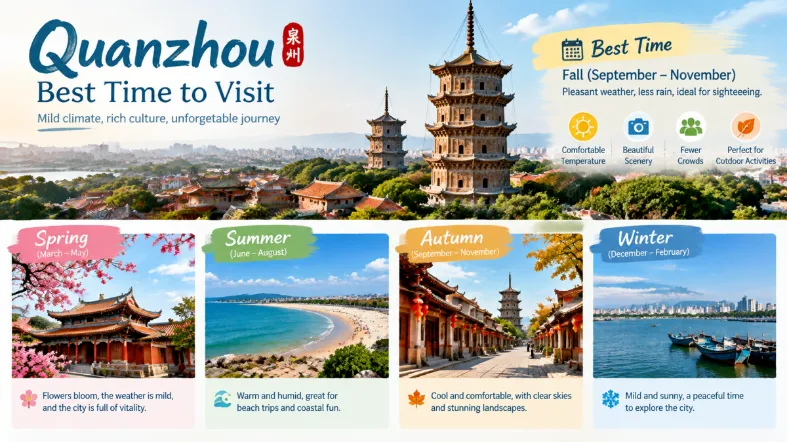
Quanzhou has a subtropical maritime climate with mild weather year‑round.
- Best seasons: Spring (March–May) and Autumn (September–November). Temperatures range from 18–28°C (64–82°F), with less rain – great for walking and outdoor activities.
- Summer (June–August): Hot and humid, temperatures can reach 35°C (95°F). Go out early and return late, and visit indoor attractions at midday. Typhoons are possible from July to September.
- Winter (December–February): Mild with little rain, average temperatures 12–18°C (54–64°F). Good for visiting temples and the ancient city, but the seaside can be windy and cold.
Avoid: Chinese public holidays such as May Day (May 1–5), National Day (October 1–7), and Spring Festival. During these times, attractions are very crowded, and hotel prices rise.
3. How to Get to Quanzhou
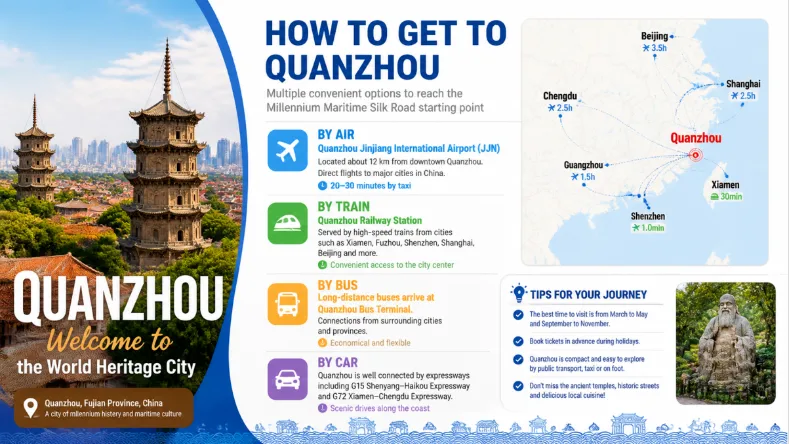
By Plane
Quanzhou Jinjiang International Airport (IATA: JJN) is located south of Quanzhou city, about 12 km (7.5 miles) from the center. The airport has direct flights to major domestic cities and some international destinations. From the airport to the city, you can take a taxi (about 30–40 RMB, 20 minutes) or an airport bus.
By High‑Speed Train
Quanzhou Station is a high‑speed rail station connecting Xiamen, Fuzhou, Shenzhen, Shanghai, Hangzhou, and other cities.
- From Xiamen North Station to Quanzhou Station: about 30 minutes, fare about 30 RMB.
- From Fuzhou South Station to Quanzhou Station: about 1 hour, fare about 60 RMB.
- From Shenzhen North Station to Quanzhou Station: about 4 hours, fare about 250 RMB.
From Xiamen
If you are already staying in Xiamen, Quanzhou is perfect for a day or two. From Xiamen Station or Xiamen North Station, take a high‑speed train to Quanzhou Station – only 30 minutes. Trains are very frequent – dozens every day.
By Long‑Distance Bus
Quanzhou has several long‑distance bus stations connecting cities within Fujian and neighboring provinces.
4. Getting Around Quanzhou
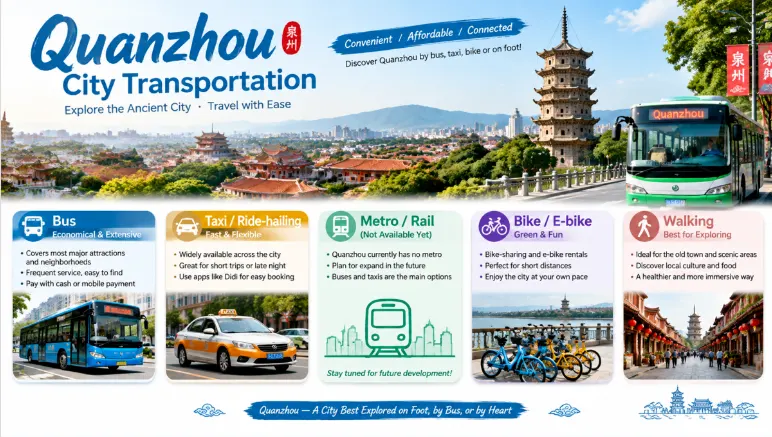
Quanzhou’s city attractions are relatively concentrated – most can be reached on foot or by short rides.
- Bus: Covers the whole city; fare 1–2 RMB. Some routes support Alipay or WeChat QR code payment.
- Taxi: Starting fare is about 9 RMB. Short trips within the city cost about 10–20 RMB.
- Ride‑hailing: Didi Chuxing is available in Quanzhou – transparent pricing, recommended.
- Shared bikes: HelloBike and Meituan Bike are available – great for short rides in the ancient city.
- Little White Electric Shuttle (Xiaobai): A sightseeing shuttle in Quanzhou’s ancient city, known as “Xiaobai.” You can flag it down anywhere. The fare is about 2 RMB – it reaches major attractions in the ancient city.
5. Must‑Visit Attractions in Quanzhou
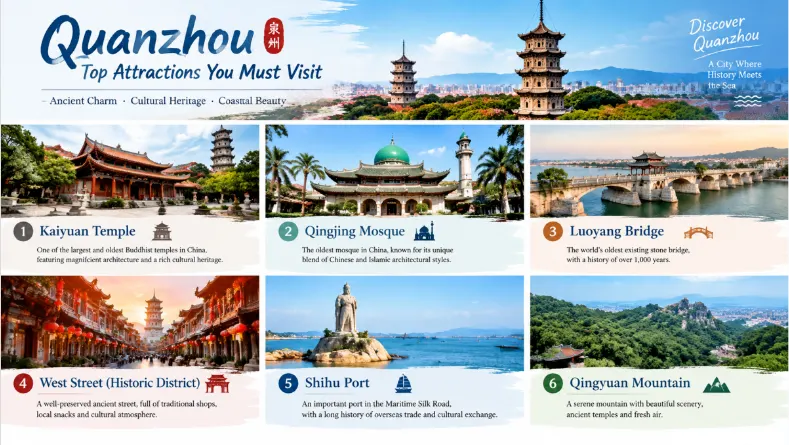
Kaiyuan Temple
Kaiyuan Temple is Quanzhou’s most famous Buddhist temple, first built in the Tang dynasty (686 AD). It is one of the largest Buddhist temples in Fujian and part of the World Heritage site. The most famous features are the Twin Pagodas – two stone pagodas built in the Song dynasty, about 48 meters (157 feet) tall, the tallest stone pagodas in China. The carvings are exquisite, and they have survived centuries of earthquakes. Entry is free, but advance reservation on the WeChat public account is required.
- Ticket: Free.
- Opening hours: 8:00 – 17:30.
- Visit duration: 1.5 hours.
West Street
West Street is Quanzhou’s oldest street, stretching from Kaiyuan Temple to the Clock Tower. It preserves many traditional Minnan buildings – red‑brick houses and arcades. The street is lined with snack shops, tea houses, craft stores, and cafes. Here, you can try local dishes such as misua paste, meat zongzi, and four‑fruit soup. West Street is also the best place to photograph the Twin Pagodas of Kaiyuan Temple.
- Ticket: Free.
- Visit duration: 1–2 hours.
Clock Tower
The Clock Tower is at the intersection of West Street and Zhongshan Road and is a landmark of Quanzhou. Built in 1934, it is a white Western‑style clock tower blending Minnan and European architectural styles. Surrounding the tower is Quanzhou’s busiest commercial area – great for photos and shopping.
Qingjing Mosque
Qingjing Mosque is one of China’s oldest Islamic mosques, first built in the Northern Song dynasty (1009 AD). It is part of the World Heritage site and reflects Quanzhou’s multicultural history as an international port during the Song and Yuan dynasties. The mosque preserves Arabic stone inscriptions, an ancient prayer hall, and the remains of a minaret. Female visitors may need to cover their hair with a shawl.
- Ticket: About 3 RMB.
- Opening hours: 8:00 – 17:30.
- Visit duration: 40 minutes.
Guanyue Temple
Guanyue Temple is the most popular Taoist temple in Quanzhou, dedicated to Guan Yu and Yue Fei. The temple is beautifully decorated, with colorful ceramic figures and dragon ornaments on the roof. Every day, many locals come to burn incense and draw fortune sticks. It is especially beautiful when illuminated at night.
- Ticket: Free.
- Opening hours: 8:00 – 18:00.
- Visit duration: 30 minutes.
Tianhou Temple
Tianhou Temple is Quanzhou’s largest Mazu temple, first built in the Song dynasty. Mazu is the sea goddess worshipped in coastal China. Quanzhou Tianhou Temple is the highest‑ranked Mazu temple in the world and part of the World Heritage site.
- Ticket: Free.
- Opening hours: 8:00 – 18:00.
- Visit duration: 40 minutes.
Luoyang Bridge
Luoyang Bridge is China’s first cross‑sea stone bridge, built in the Northern Song dynasty (1053 AD). It is about 834 meters (2,736 feet) long, connecting Quanzhou and Hui’an County. The bridge used unique “raft foundations” and “oyster‑based reinforcement” techniques – a masterpiece of ancient Chinese bridge engineering. There are stone pagodas, stone generals, and inscriptions on the bridge. A walk on the bridge in the late afternoon offers views of the Luoyang River.
- Ticket: Free.
- Visit duration: 1 hour.
- Transport: About 40 minutes by bus from Quanzhou city.
Qingyuan Mountain
Qingyuan Mountain is the highest hill in Quanzhou, about 498 meters (1,634 feet) above sea level. On the mountain is the Laotzi Rock – a giant Song‑dynasty stone statue of Laozi, about 5 meters (16 feet) tall, the largest existing Taoist stone carving in China. There are also temples, cliff inscriptions, and viewing platforms with panoramic views of Quanzhou.
- Ticket: About 70 RMB.
- Opening hours: 6:00 – 18:00.
- Visit duration: 2–3 hours.
Xunpu Village
Xunpu Village is a traditional fishing village in Quanzhou, located at the mouth of the Jinjiang River. The women here are known as “Xunpu women” and wear floral headdresses called “Zanhuawei.” You can experience wearing a Zanhuawei (about 40 RMB, including costume and hairstyling) and take photos in front of oyster‑shell houses (houses built with oyster shells). This is a very popular cultural experience for foreign visitors.
- Ticket: Free.
- Visit duration: 1.5–2 hours.
- Transport: About 20 minutes by taxi from Quanzhou city.
Chongwu Ancient City
Chongwu Ancient City is located in Hui’an County – a stone city built in the Ming dynasty to defend against Japanese pirates. The walls are made entirely of granite and are well preserved. Outside the city are beautiful beaches and a coastline. This is also a settlement of Hui’an women, where you can learn about their distinctive clothing and culture.
- Ticket: About 45 RMB.
- Visit duration: 2–3 hours.
- Transport: Take a bus from Quanzhou Bus Center to Chongwu – about 1 hour.
Quanzhou Maritime Museum
If you want to understand Quanzhou’s history as a world maritime trade center during the Song and Yuan dynasties, this museum is a must. It displays ancient ships, Arabic tombstones, spices, ceramics, and relics of foreign merchants.
- Ticket: Free.
- Opening hours: 9:00 – 17:00 (closed on Mondays).
- Visit duration: 1.5 hours.
Wudianshi Traditional Block
Wudianshi is located in Jinjiang City – a well‑preserved traditional Minnan neighborhood. It features Ming and Qing red‑brick houses, ancestral halls, and arcades. Now converted into a cultural district with cafes, restaurants, and craft shops. Great for photos and relaxing.
- Ticket: Free.
- Visit duration: 1.5 hours.
- Transport: About 20 minutes by taxi from Quanzhou city.

6. Quanzhou Food Recommendations
Quanzhou is an important birthplace of Minnan cuisine. The snacks here are diverse, cheap, and authentic. Here are some must‑try dishes:
- Misua Paste (Mianxian Hu): Very thin noodles cooked into a paste, with toppings like pork intestine, pork liver, shrimp, and braised egg, sprinkled with pepper. Usually eaten for breakfast. Price: about 8–15 RMB.
- Meat Zongzi (Shaorou Zong): Glutinous rice wrapped around pork belly, shiitake mushrooms, dried shrimp, and braised egg, then steamed in bamboo leaves. Eaten with sweet chili sauce and peanut sauce. Price: about 8–12 RMB.
- Tusun Jelly (土笋冻): A gelatinous cold dish made from sand worms (Sipunculida). Refreshing texture, served with garlic soy sauce and pickled radish. Price: about 10–15 RMB.
- Oyster Omelet (Haili Jian): Small oysters pan‑fried with egg and sweet potato starch – crispy outside, tender inside. Price: about 15–20 RMB.
- Ginger Duck (Jiangmu Ya): Duck stewed with old ginger and rice wine – rich aroma, warming and nourishing. Price: about 40–60 RMB (half duck).
- Beef Soup (Niurou Geng): Minced beef made into a thick soup – smooth and tender. Price: about 10–15 RMB.
- Four Fruit Soup (Siguo Tang): Shaved ice with red beans, mung beans, coix seeds, watermelon, pineapple, and honey water. Price: about 6–10 RMB.
- Runbing Rolls (润饼菜): Thin pancakes wrapped with shredded carrot, bean sprouts, seaweed, crushed peanuts, and more – rich texture. Price: about 8–12 RMB.
Recommended food places:
- West Street: Misua paste, meat zongzi, four-fruit soup.
- Zhongshan Road: Beef soup, oyster omelet.
- Near the Clock Tower: Ginger duck, running rolls.
- Wudianshi, Jinjiang: A concentration of various Minnan snacks.
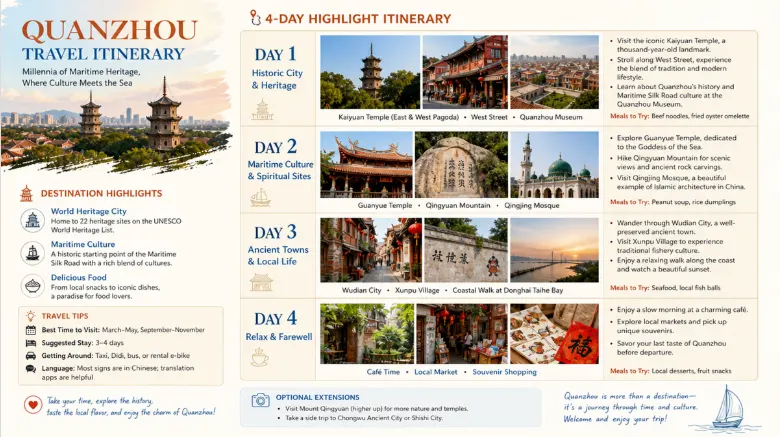
7. Suggested Itineraries
One‑Day Trip (From Xiamen)
- 8:00 AM – Take a high‑speed train from Xiamen to Quanzhou (30 minutes).
- 9:00–10:30 – Visit Kaiyuan Temple and the Twin Pagodas.
- 10:30–12:00 – Stroll along West Street and try snacks.
- 12:00–13:00 – Lunch (misua paste, meat zongzi).
- 13:00–14:00 – Visit Qingjing Mosque and Guanyue Temple.
- 14:00–15:30 – Visit Tianhou Temple and Luoyang Bridge.
- 16:00 – Return to Quanzhou Station and take the train back to Xiamen.
Two‑Day Trip (In‑Depth)
- Day 1: Kaiyuan Temple, West Street, Clock Tower, Qingjing Mosque, Guanyue Temple, Tianhou Temple. Evening: snacks on West Street.
- Day 2: Morning – Qingyuan Mountain. Afternoon – Xunpu Village (Zanhuawei experience). Evening – sunset at Luoyang Bridge.
Three‑Day Trip (Panorama)
On the basis of the two‑day trip, add a third day: morning – Chongwu Ancient City. Afternoon – Wudianshi Traditional Block. Return in the evening.
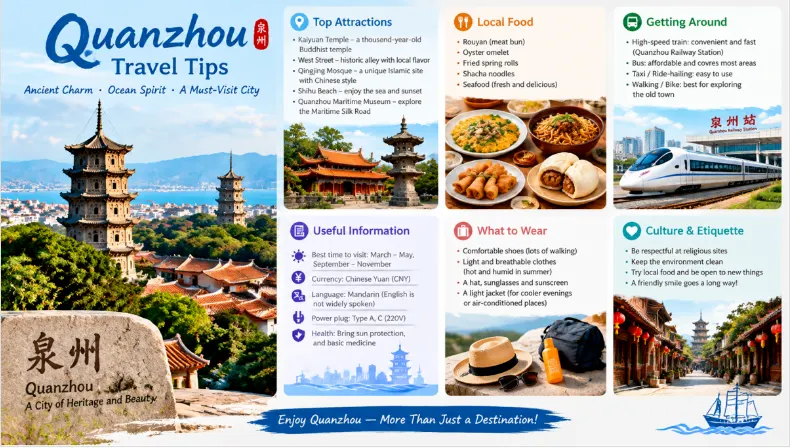
8. Practical Travel Tips for Quanzhou
- Language: Quanzhou mainly speaks Minnan (Hokkien), but tourist areas, hotels, and young people can speak Mandarin. Most taxi drivers speak only Mandarin or Minnan. Use a translation app.
- Currency & Payment: The currency is RMB. Almost all shops and restaurants accept WeChat Pay and Alipay. Carry 200–300 RMB in cash as a backup.
- Visa: Foreign tourists need a valid Chinese visa. Xiamen Gaoqi International Airport offers 144‑hour visa‑free transit, but check whether Quanzhou is included in the visa‑free area in advance.
- Clothing: Quanzhou is hot in summer – wear light, breathable clothing. When visiting temples, avoid shorts or overly revealing clothes. Qingyuan Mountain and Chongwu Ancient City require walking – wear comfortable sports shoes.
- Sun protection: UV rays are strong – bring sunscreen, a sun hat, and sunglasses.
- Drinking water: Drink bottled water. Tea served in restaurants is usually safe.
- Internet: Most public places in China offer free Wi‑Fi, but a Chinese phone number is often needed for verification. Buy a local SIM card or use international roaming.
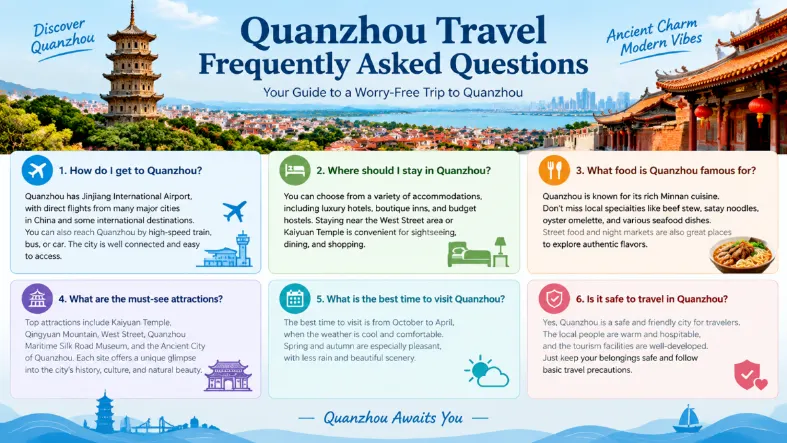
Frequently Asked Questions (FAQ)
Q: Which is more worth visiting – Quanzhou or Xiamen?
A: They have different styles. Xiamen is a modern coastal city with Gulangyu and beautiful beaches. Quanzhou is a historic city with rich World Heritage sites and traditional culture. If time allows, visit both. The high‑speed train from Xiamen to Quanzhou takes only 30 minutes.
Q: How many days do I need for Quanzhou?
A: For the main city attractions, 1–2 days are enough. For deeper exploration, including Qingyuan Mountain, Xunpu Village, Chongwu Ancient City, and Wudianshi, 3 days are recommended.
Q: Are there English‑speaking guides in Quanzhou?
A: There are some English guide services in Quanzhou, but not as common as in Xiamen. It is recommended to book in advance through travel platforms or use a translation app for self‑guided tours. Major attractions have bilingual signs.
Q: Is Quanzhou safe?
A: Quanzhou has good public security, and tourist areas are safe. Still, keep your passport and valuables secure, and avoid going alone to remote areas at night.
Q: Is Quanzhou food suitable for foreign palates?
A: Most Quanzhou dishes are light and fresh – suitable for foreign visitors. Misua paste, meat zongzi, oyster omelet, and four-fruit soup are all popular. If you do not eat offal or seafood, tell the shop owner in advance.
Q: Can I do a day trip from Xiamen to Quanzhou?
A: Yes. The high‑speed train from Xiamen to Quanzhou takes only 30 minutes, with frequent departures. Leave in the morning and return in the evening – you can visit Kaiyuan Temple, West Street, Qingjing Mosque, Guanyue Temple, and Tianhou Temple.
Q: What souvenirs are worth buying in Quanzhou?
A: Quanzhou specialties include: Tieguanyin tea, Dehua white porcelain, Hui’an stone carvings, puppet heads, aged vinegar, and Yuanhetang preserved fruits. There are many souvenir shops on West Street and in Wudianshi.
Q: Do foreign tourists need a special permit for Quanzhou?
A: No. Quanzhou is fully open to foreign visitors with a valid Chinese visa.
Q: What are the best photo spots in Quanzhou?
A: West Street (for the Twin Pagodas of Kaiyuan Temple), the Clock Tower, Qingjing Mosque, Guanyue Temple, Luoyang Bridge, Xunpu Village (Zanhuawei), Chongwu Ancient City coast, and Wudianshi red‑brick houses.
Related Reading:
- Zhangzhou Attractions Guide: Tulou, Dongshan Island, Volcano & Ancient Town
- Zhangzhou Travel Guide: Tulou, Dongshan Island & Local Food
- Zhangzhou Food Guide: Must-Try Dishes & Where to Eat
- How Many Days Do You Need in Xiamen? 2026 Itinerary Guide
- Fujian Tulou 2026 Guide: Visiting China’s Hakka Earth Buildings
- Fujian Travel Guide 2026: Discover Tulou, Wuyishan, Xiamen & More
- Fuzhou Travel Guide 2026: Best Things to Do, Eat & See in Fujian’s Capital
- Xiamen Food Recommendations: Top 10 Must-Try Dishes for 2026
- What to Do in Xiamen: Your Complete 2026 Travel Guide & Itinerary