Zhangzhou Ancient City: A Living Museum of Minnan Culture
Zhangzhou Ancient City
If you want to experience the real old Fujian – not a tourist‑crowded replica commercial street – then Zhangzhou Ancient City is your best choice. Located in the center of Zhangzhou city, this ancient district has a history of over 1,300 years. Unlike other ancient towns that have been heavily commercialized, Zhangzhou Ancient City still retains its original, living character – residents live, work, shop, and drink tea here. Visitors can genuinely experience the daily life of Minnan (southern Fujian) people. This guide provides detailed information on the history, highlights, food, and transportation of Zhangzhou Ancient City.
1. Zhangzhou Ancient City Overview
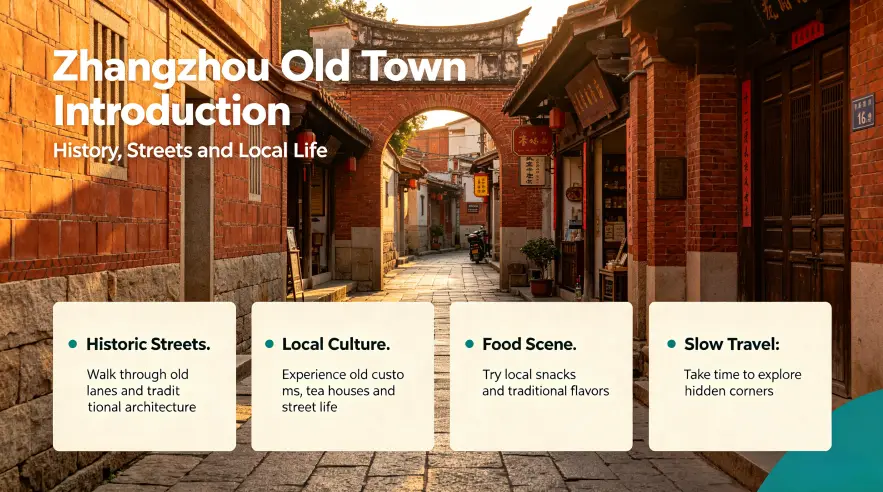
The history of Zhangzhou Ancient City dates back to the Tang dynasty (618–907 AD). Zhangzhou was established as a prefecture in 686 AD, with the ancient city area serving as its urban center at the time. Through the Song, Yuan, Ming, Qing, and Republican periods, the basic layout of the ancient city has been preserved to this day.
The core area of Zhangzhou Ancient City covers about 1 square kilometer (0.4 square miles). It retains the road layout from the Tang and Song dynasties, architectural styles from the Ming and Qing dynasties, and commercial arcade buildings from the Republican period. It is designated as a Chinese Historical and Cultural District and is one of the best‑preserved ancient cities in Fujian Province. More importantly, it is not a tourist attraction – it is a living community, with about 17,000 residents still living here.
2. How to Get to Zhangzhou Ancient City
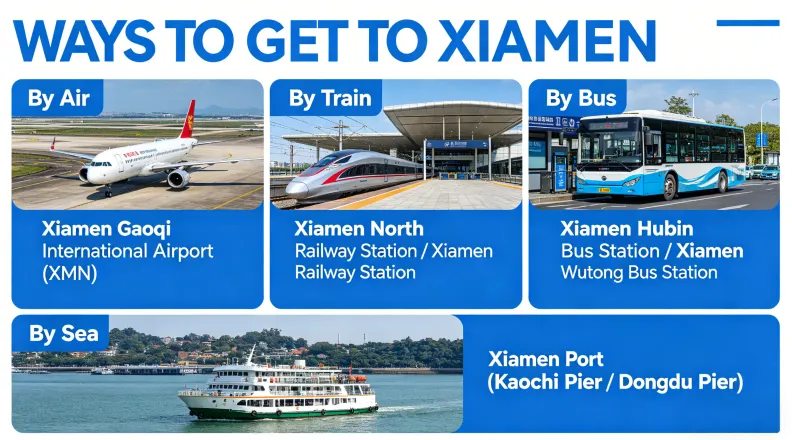
From Xiamen (Most Common)
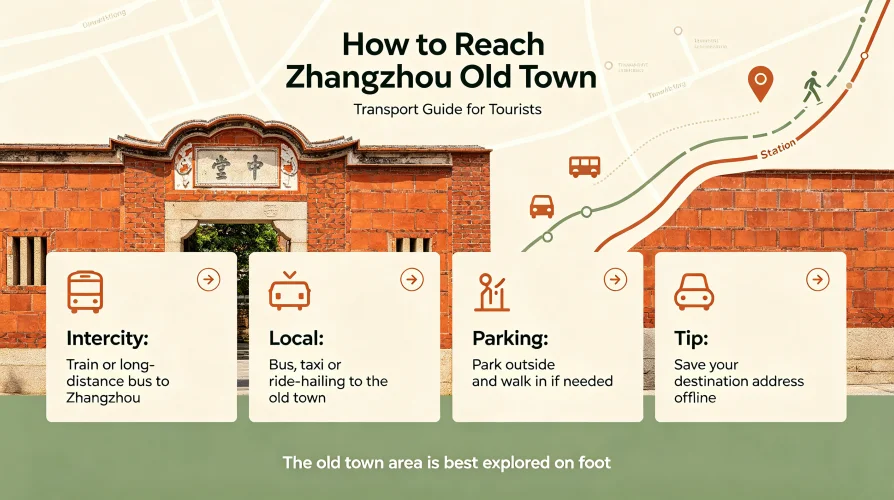
- High‑speed train/bullet train: Take a train from Xiamen Station or Xiamen North Station to Zhangzhou Station (about 30 minutes, fare 15–25 RMB). After arriving at Zhangzhou Station, take a taxi or ride‑hailing car to “Zhangzhou Ancient City” or “Zhongshan Park” – about 15 minutes, costing about 20 RMB. You can also take bus 11 or 25.
- Bus: Take a bus from Xiamen Wucun Bus Station or Fanghu Bus Center to Zhangzhou Bus Center (about 1.5 hours, fare about 30 RMB), then take a taxi to the ancient city (about 10 minutes).
- Self‑drive: From Xiamen, cross the Xiamen–Zhangzhou Bridge to Zhangzhou city – about 1 hour.
From Zhangzhou city
- Take bus V1, V2 (ancient city micro‑circulation bus), 11, 25, 31, etc., and get off at “Zhangzhou Ancient City” or “Zhongshan Park” station.
- Take a taxi or ride‑hailing car directly to “Zhangzhou Ancient City.”
3. Main Highlights of the Ancient City
Taiwan Road and Hong Kong Road
Taiwan Road and Hong Kong Road are the two most central streets of Zhangzhou Ancient City, the essence of the district. These streets were formed in the Ming dynasty and flourished in the Republican period, serving as the most prosperous commercial streets in Zhangzhou’s history.
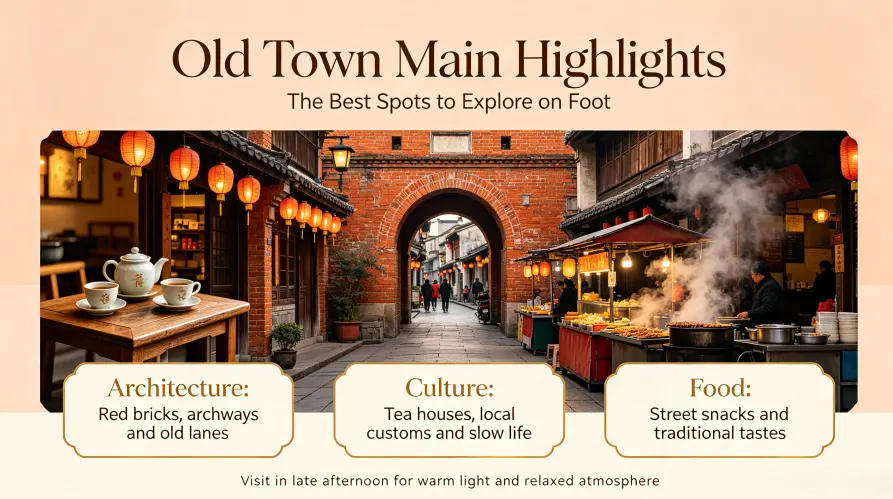
- Taiwan Road: About 500 meters (1,640 feet) long. The street is lined with arcade buildings built during the Republican period (a type of mixed‑use building with shops on the ground floor and residences above). The colonnades of the arcades form covered walkways that provide shade and shelter from rain. The architecture combines traditional Minnan style with Western classical elements, such as arched windows, Roman columns, and pediment decorations.
- Hong Kong Road: Intersects with Taiwan Road and similarly preserves beautiful arcade buildings. Three Ming‑dynasty stone memorial arches remain on the street: Shangshu Tanhua Arch, Sanshi Zai’er Arch, and Weixin Liufang Arch. These stone arches were erected by emperors to honor local officials. They are finely carved and have high historical and artistic value.
Visit tip: Stroll along these two streets, look up at the architectural details, and look down at the stone pavement beneath your feet. The streets still have many old shops – traditional Chinese medicine stores, craft workshops, and old tea houses – allowing you to feel the commercial atmosphere of a hundred years ago.
Zhangzhou Confucian Temple
Zhangzhou Confucian Temple was first built in the Song dynasty (11th century). It is one of the largest surviving Confucian temple complexes in Fujian Province. Confucian temples were places for worshipping Confucius and conducting official education. The existing buildings include the Dacheng Hall, the two side corridors, and the Ji Gate. The main structure, Dacheng Hall, retains the wooden frame style of the Song dynasty and is one of the oldest wooden buildings in the Minnan region.
- Ticket: Free.
- Opening hours: 8:30–17:30.
- Highlights: The statue of Confucius inside Dacheng Hall; the unique Song‑dynasty wooden frame structure (such as “pillar reduction” and “pillar shifting” techniques); the Ming‑dynasty stone steles preserved in front of the hall.
Zhangzhou Intangible Cultural Heritage Exhibition Hall
This exhibition hall is located inside an old building in the ancient city. It showcases various intangible cultural heritage items of Zhangzhou, including:
- Puppet head carving: Zhangzhou puppet head carving is a national‑level intangible cultural heritage. The heads are carved from camphor wood, with vivid expressions and diverse appearances.
- Glove puppetry (Budai Xi): Zhangzhou glove puppetry is a type of puppet show with puppets the size of a palm. The performer puts their hand inside the puppet to control it, accompanied by music and singing to tell a story.
- Zhangzhou paper cutting: Known for fine patterns and smooth lines.
- Narcissus flower carving: Zhangzhou is China’s main producer of narcissus flowers. Local flower growers have a unique skill of carving the flower bulbs for artistic shaping.
- Ticket: Free.
- Opening hours: 9:00–17:00 (closed on Mondays).
- Tip: The hall hosts live demonstrations – you can watch the artisans at work up close.
Time‑Honored Snack Shops in the Ancient City
Zhangzhou Ancient City is the best place to taste authentic Zhangzhou food. The streets are lined with many time‑honored snack shops – you can eat as you explore.
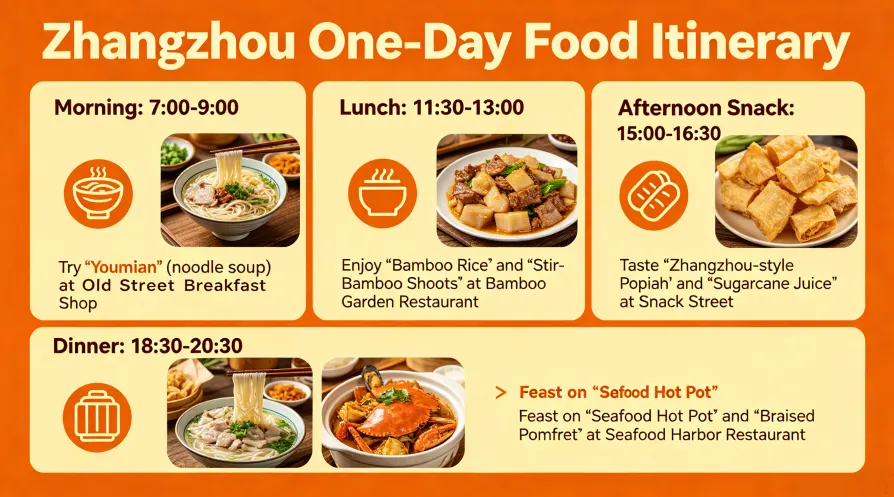
- Fu Cheng Snack Street: The most concentrated food area in the ancient city, offering hand‑grasped noodles, braised noodles, five‑spice rolls, mochi, and more.
- Qingnian Road: Home to old shops for four‑fruit soup and tofu pudding with vermicelli.
- Taiwan Road: Satay noodles, seafood porridge, and more.
Zhongshan Park
Zhongshan Park is located on the north side of the ancient city. It is Zhangzhou’s earliest park, built in 1927 (during the Republican period) and named after Dr. Sun Yat‑sen. The park features ancient banyan trees, rockeries, pavilions, and a monument. It is a place where elderly locals do morning exercises and residents relax. The west gate of the park leads directly into the core area of the ancient city.
- Ticket: Free.
- Opening hours: All day.
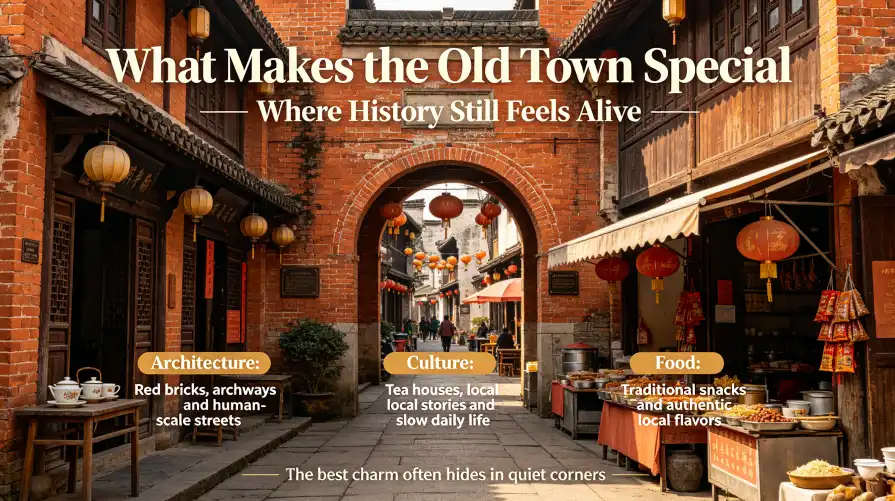
4. What Makes This Ancient City Special – Why Is It “Living”?
Many ancient towns (such as Lijiang and Pingyao) are beautiful, but the original residents have moved out, and they have become purely commercial tourist districts. Zhangzhou Ancient City is different – it is still home to local people.
- At 7 AM, you will see residents buying breakfast and taking children to school.
- At noon, old tea houses are full of elderly people drinking tea and playing chess.
- In the evening, the market is still lively, with residents buying ingredients for dinner.
- The shops on the streets are not souvenir shops for tourists; they are grocery stores, tailors, and general merchandise stores serving local people.
This authentic living atmosphere is the most precious quality of Zhangzhou Ancient City. Here, you can feel the real daily rhythm of the Minnan people.
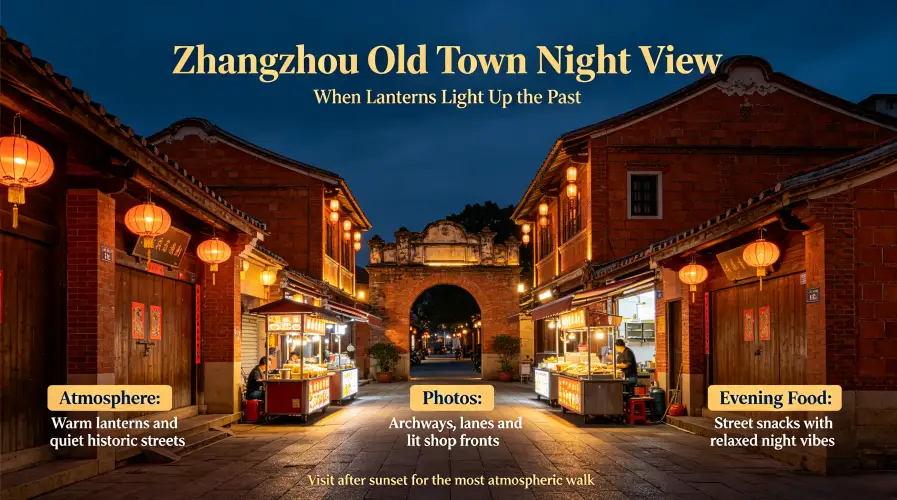
5. Zhangzhou Ancient City at Night
When night falls, the red lanterns that hang throughout the ancient city are lit up, bathing the streets in warm yellow light. The ancient city at night is quieter than during the day, with fewer tourists, and the outlines of the arcade buildings look especially beautiful under the lights. Night market stalls begin to operate, offering grilled skewers, fried snacks, four‑fruit soup, and other treats.
Best time to visit: 5 PM – 9 PM. You can admire the architectural details during the day, have dinner in the ancient city, and then enjoy the night views.
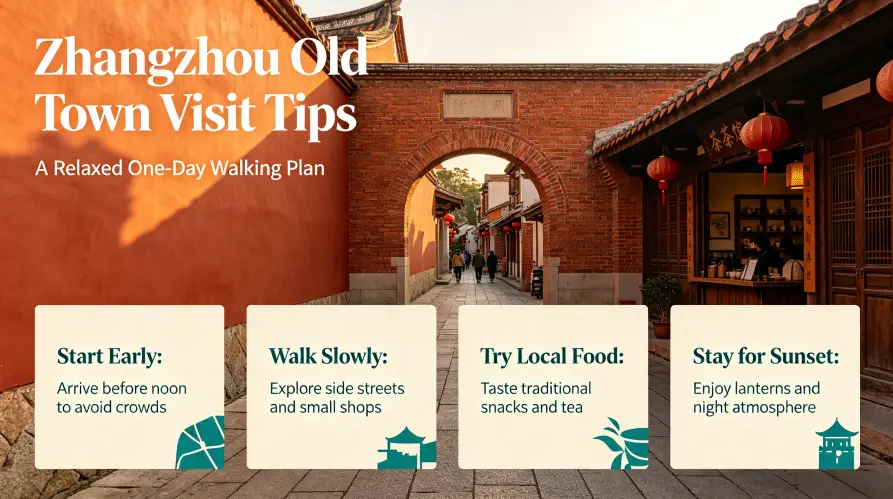
6. Visit Tips
- Visit duration: For the main streets and the Confucian Temple only – about 2 hours. If you include food tasting, the intangible heritage hall, and photography, allow 3–4 hours.
- Best seasons: Spring (March–May) and Autumn (September–November) have comfortable weather. Summer is hot – visit in the morning or evening. Winter is mild – good for daytime visits.
- Clothing: The ancient city streets are mostly paved with stone slabs – wear comfortable flat shoes. In summer, bring a parasol or hat.
- Language: Elderly residents mainly speak Minnan (Hokkien), but shop owners can mostly speak Mandarin. Have the Chinese names ready or use a translation app.
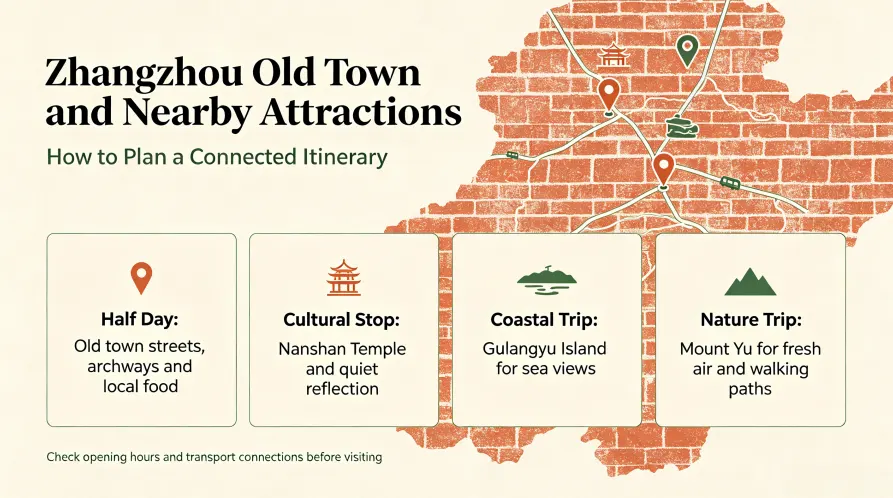
7. Connecting with Nearby Attractions
Zhangzhou Ancient City is in the center of Zhangzhou city. Several nearby attractions can be combined:
- Zhangzhou Nanshan Temple: Located on the south bank of the Jiulong River, across the river from the ancient city. This temple was first built in the Tang dynasty. A taxi ride from the ancient city takes about 10 minutes.
- Yundongyan: A famous scenic area in Zhangzhou, known for its unusual granite caves and cliff carvings. A taxi ride from the ancient city takes about 25 minutes.
- Zhangzhou Museum: Displays the history and culture of Zhangzhou. A taxi ride from the ancient city takes about 15 minutes.
If you plan to spend one day in Zhangzhou, we recommend: morning – visit the ancient city + Confucian Temple + intangible heritage hall; lunch – try snacks in the ancient city; afternoon – visit Nanshan Temple or Yundongyan; evening – return to the ancient city for the night views.
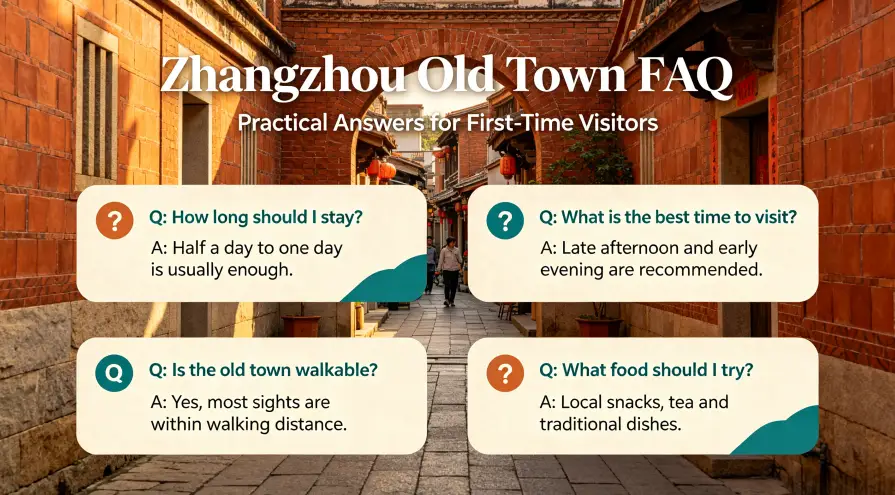
Frequently Asked Questions (FAQ)
Q: Does Zhangzhou Ancient City charge an entrance fee?
A: No. Zhangzhou Ancient City is a free‑access, open‑air district – there is no gate or ticket. The Confucian Temple and the intangible heritage hall are also free.
Q: What is the difference between Zhangzhou Ancient City and Xiamen Zhongshan Road Pedestrian Street?
A: Xiamen Zhongshan Road is a commercial pedestrian street mainly serving tourists, with mostly chain stores and souvenir shops. Zhangzhou Ancient City is a real living neighborhood, with shops serving residents and preserving the authentic Minnan lifestyle. Zhangzhou Ancient City is quieter, more genuine, and cheaper.
Q: Is Zhangzhou Ancient City suitable for the elderly and children?
A: Very suitable. The streets are flat and suitable for wheelchairs and strollers. The Confucian Temple and the intangible heritage hall are both on level ground. There are many snack shops along the streets – good for children. However, be careful – the stone pavement can be slippery on rainy days.
Q: Does Zhangzhou Ancient City have English signs or English maps?
A: Major intersections have bilingual (Chinese‑English) directional signs, but detailed descriptions are mostly in Chinese. It is recommended to use a maps app (e.g., Baidu Maps, Gaode Maps) for navigation. The intangible heritage hall has simple English labels.
Q: How long does it take to explore Zhangzhou Ancient City?
A: A quick visit (main streets + Confucian Temple) – about 2 hours. An in‑depth visit (including intangible heritage hall, food tasting, and photography) – about 3–4 hours. If you also want to have tea and rest in a tea house, allow half a day.
Q: Is Zhangzhou Ancient City safe at night?
A: Very safe. Zhangzhou has good public security. The ancient city is well-lit at night, with surveillance cameras and patrols. But keep an eye on your personal belongings, just as you would in any city.
Q: Is there accommodation inside Zhangzhou Ancient City?
A: There are some boutique guesthouses and inns inside the ancient city, such as “Ancient City Inn” and “Old Street Guesthouse” – prices about 150–300 RMB per night. There are more budget hotels around the ancient city.
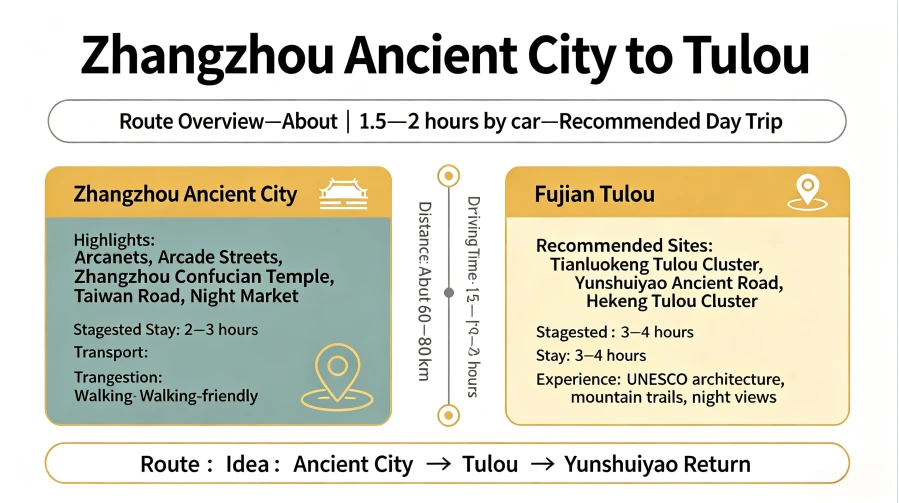
Q: How do I get from Zhangzhou Ancient City to Nanjing Tulou?
A: You can take a direct bus from Zhangzhou Bus Center to Nanjing Tulou (several buses daily, about 1.5 hours), or hire a private car (about 300–400 RMB per day). It is recommended to book a day tour on a travel platform the day before.
Zhangzhou Ancient City is a rare gem in Fujian – an authentic, living historical district where time seems to slow down. Unlike many restored tourist streets, this is a place where you can truly connect with the rhythm of local life. Whether you come to admire the architecture, taste the local food, or simply sit in an old tea house and watch the world go by, Zhangzhou Ancient City offers a peaceful and genuine experience of old Fujian.
Plan your visit to Zhangzhou Ancient City and step into a living museum of Minnan history!
Related Reading:
- Dongshan Island Travel Guide: Beaches, Attractions & Tips
- Zhangzhou Attractions Guide: Tulou, Dongshan Island, Volcano & Ancient Town
- Zhangzhou Travel Guide: Tulou, Dongshan Island & Local Food
- Xiamen Metro Lines Guide: Routes, Stations, Fares & Tips (2026)
- 2026 Xiamen Transportation Guide: Metro, Bus, Ferry & Taxi Tips for Foreigners
- Where Is Zhangzhou? 2026 Travel Guide from Xiamen to Tulou & More
- How Many Days Do You Need in Xiamen? 2026 Itinerary Guide
- Gulangyu Island Travel Guide: Ferry Tickets, Attractions & Tips 2026
- Xiamen Travel Guide 2026: Top 10 Attractions + 3-Day Itinerary
- Xiamen Night Market Guide 2026: Best Food & Top Places to Visit
- Best Places to Eat in Xiamen: 2026 Food Guide & Local Restaurant Tips