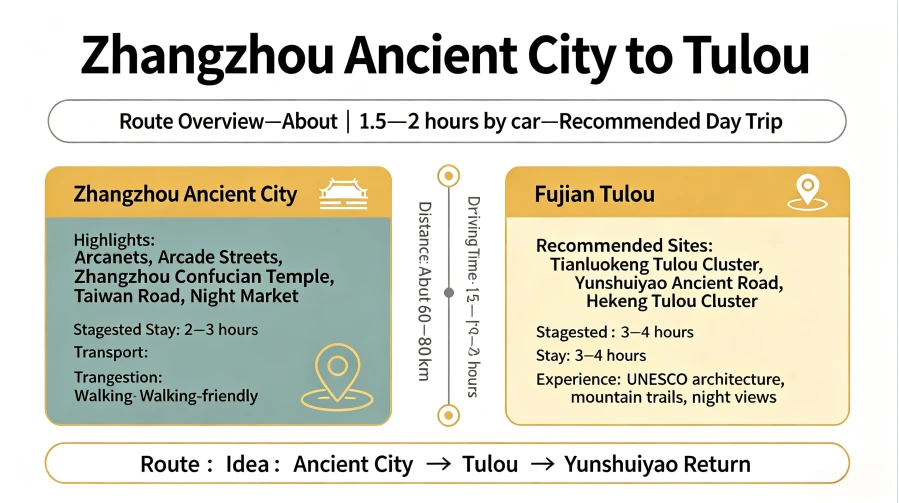
Zhangzhou Tianluokeng : The Iconic Landscape of Fujian Tulou
If you search for images of Fujian Tulou online, the picture you see is most likely the Tianluokeng Tulou Cluster. Located in Nanjing County, Zhangzhou City, Fujian Province, Tianluokeng is the most representative landscape of Fujian Tulou. Four round tulou surround one square tulou. From the observation deck on the hilltop, the shape looks like a table of dishes – hence the nickname “Four Dishes and One Soup.” In 2008, Tianluokeng was inscribed as part of the “Fujian Tulou” UNESCO World Heritage Site. This guide provides detailed information on what to see, how to get there, ticket prices, and travel tips.

1. Tianluokeng Tulou Cluster Overview
The Tianluokeng Tulou Cluster is located in Shuyang Town, Nanjing County. It consists of five tulou: one square tulou (Builou), three round tulou (Hecang Lou, Zhenchang Lou, Ruiyun Lou), and one oval tulou (Wenchang Lou). They were built at different times, spanning from 1796 to 1966 – a period of about 170 years. The five tulou are built on a hillside in a staggered arrangement. Viewed from above, the square Builou sits in the center, with four round tulou at the four corners, forming a unique geometric pattern.
There are two local stories about the name “Tianluokeng.” One says the valley resembles the shape of a “tianluo” (a kind of freshwater snail that lives in rice paddies). The other says the area used to be rich in these snails, which were an important food source for villagers. Either way, the name has been in use for centuries.

2. Detailed Introduction to the Five Tulou
Builou (Square Tulou)
Builou was the first tulou built in the Tianluokeng cluster – constructed in 1796 during the Qing dynasty’s Jiaqing reign. It is the only square tulou among the five and sits at the center. The name “Builou” means “step onto the clouds,” symbolizing the family’s rise in status and success for future generations. Builou has three storeys, with 26 rooms on each floor.
Hecang Lou (Round Tulou)
Hecang Lou is located to the upper left of Builou and was built in 1936. It is one of the three round tulou and has a diameter of about 33 meters (108 feet) and three storeys. Inside, there is a well with clear water that is still in use today.
Zhenchang Lou (Round Tulou)
Zhenchang Lou is located to the upper right of Builou and was built in 1930. It is similar in size to Hecang Lou, with a diameter of about 32 meters (105 feet) and three storeys. The ground floor served as kitchens and dining rooms, the second floor as storage, and the third floor as bedrooms.
Ruiyun Lou (Round Tulou)
Ruiyun Lou is located to the lower left of Builou and was built in 1936. It is the smallest of the three round tulou but has the most intact structure. The wooden carvings and window decorations inside are delicate and worth a close look.
Wenchang Lou (Oval Tulou)
Wenchang Lou is located to the lower right of Builou and was built in 1966 – the latest of the five. Its shape is not perfectly round but oval (like a rugby ball), which is relatively rare among Fujian Tulou.
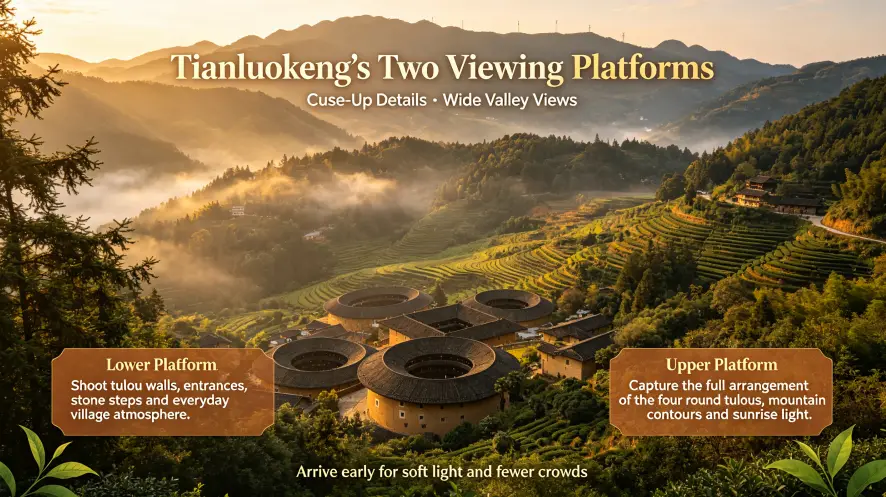
3. The Two Main Observation Decks
Tianluokeng has two main observation decks offering different views of the tulou cluster.
Upper Observation Deck (Panoramic View from Above)
The upper observation deck is on the hillside above the tulou cluster. From here, looking down, you can see all five tulou clearly – the square Builou looks like a “plate,” and the four round tulou look like “bowls,” truly resembling a table of dishes. This is the best spot to capture the iconic panoramic shot of Tianluokeng – most promotional photos are taken here.
Note: The upper observation deck is near the scenic area entrance. If you go there first, you can walk downhill (about 15 minutes) into the tulou cluster.
Lower Observation Deck (View from Below)
The lower observation deck is in the valley below the tulou cluster. From here, looking up, the tulou are built on the hillside in layers, with green mountains and blue sky behind them. This angle shows the beautiful integration of the tulou with the natural landscape.
Recommendation: First, go to the upper observation deck for the panoramic view, then walk down into the tulou cluster to see the interiors, and finally leave from the lower observation deck (or return the same way). The whole visit takes about 1.5–2 hours.

4. Tianluokeng and Yuchang Lou
Yuchang Lou (the “Leaning Tower”) is located near Tianluokeng, about a 10‑minute drive away. Visitors usually combine Tianluokeng and Yuchang Lou in one trip. Yuchang Lou, built in 1308, is one of the oldest tulou in China, famous for its tilted pillars. If you have time, it is recommended to visit both.
Combo ticket information: The Nanjing Tulou scenic area usually sells a combo ticket covering Tianluokeng, Yuchang Lou, Taxia Village, and more – price about 100–150 RMB. You can also buy a separate ticket for Tianluokeng.

5. How to Get to Tianluokeng
From Xiamen
- High‑speed train + bus: Take a bullet train from Xiamen North Station or Xiamen Station to Nanjing Station (about 40 minutes, fare about 30 RMB). After exiting, take the shuttle bus to Tianluokeng (about 1 hour, fare about 20 RMB). This is the most economical public transport option.
- Direct bus: Xiamen Hubin South Bus Station has direct buses to Nanjing Tulou, but there are only 1–2 per day. The journey takes about 2.5 hours.
- Private car / day tour: The most convenient option. The drive from Xiamen to Tianluokeng takes about 2.5 hours. Private car rental costs about 400–600 RMB per day (including driver).
From Zhangzhou city
- Bus + transfer: Take a bus from Zhangzhou Bus Center to Nanjing county town, then transfer to a local bus to Tianluokeng. Or hire a private car – about 1.5 hours.
Getting around the scenic area
- There are electric sightseeing buses (shuttles) connecting Tianluokeng, Yuchang Lou, and Taxia Village. The cost is either included in the ticket or a separate fee of about 15 RMB.
6. Ticket Information
- Tianluokeng Tulou Cluster ticket: About 90–100 RMB (includes upper observation deck, lower observation deck, and interior access to the five tulou).
- Nanjing Tulou combo ticket: About 100–150 RMB (includes Tianluokeng, Yuchang Lou, Taxia Village, etc.).
- Discounts: Students, seniors, and children get half price with valid ID.
- Opening hours: 8:00 – 17:30.
7. Best Time to Visit
- Spring (March–May): Warm weather, wildflowers blooming in the mountains – good for hiking and photography.
- Autumn (September–November): Clear, cool weather, high visibility – the best season.
- Summer (June–August): Hot and rainy, but the mountains are cool; rain and fog may affect views from the observation decks.
- Winter (December–February): Mild with little rain, fewer tourists, but chilly in the mornings and evenings – bring a jacket.
- Best time of day: Before 9 AM and after 3 PM – soft light for photography. Midday light is too harsh and may overexpose photos.
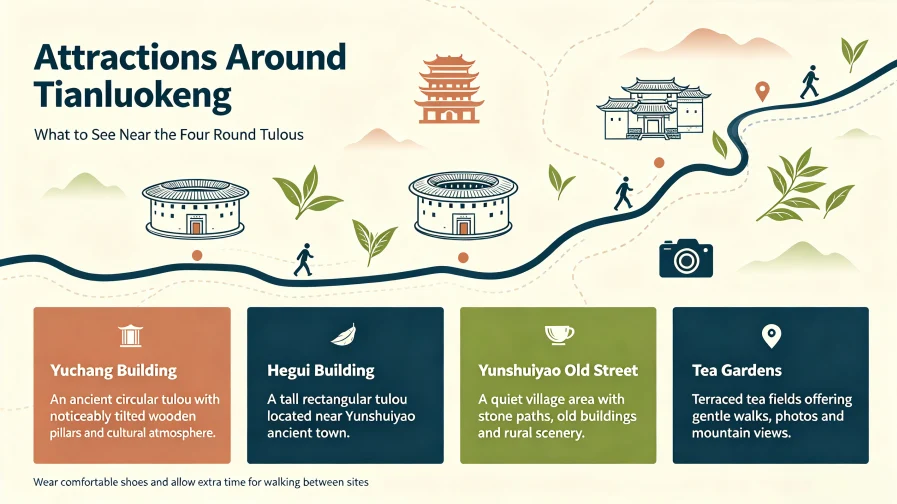
8. Attractions Near Tianluokeng
Yuchang Lou (The Leaning Tower)
About a 10‑minute drive from Tianluokeng. Built in 1308, it is one of the oldest tulou in China. Some of its pillars are visibly tilted but have stood firmly for over 700 years. Ticket about 50 RMB (or included in the combo ticket).
Taxia Village
About a 15‑minute drive from Tianluokeng. Taxia Village is a small village built along a stream, known as the “Zhouzhuang of Southern Fujian.” It has dozens of tulou and a stone arch bridge from the Ming dynasty. The village has fewer tourists and is very peaceful.
Yun Shui Yao Ancient Town
About a 20‑minute drive from Tianluokeng. Famous as the filming location of the movie Yun Shui Yao, with thousand‑year‑old banyan trees and an ancient road by the stream. (See our dedicated article on Yun Shui Yao.)
Itinerary suggestion: Tianluokeng + Yuchang Lou + Taxia Village can be done in half a day to a full day. If you also visit Yun Shui Yao, plan for two days.
9. Accommodation Recommendations
There are various accommodation options in and around Tianluokeng.
- Tulou guesthouses: Stay in a room inside a tulou – a rustic but very atmospheric experience. Basic facilities, but unique. Price about 150–300 RMB per night.
- Taxia Village guesthouses: Quieter environment, scenic riverside inns. Price about 200–400 RMB per night.
- Recommended booking platforms: Trip.com, Agoda, Booking.com. Book at least one week in advance.
10. Practical Travel Tips
- Clothing: There are mountain paths and steps – wear comfortable sports shoes or hiking shoes.
- Sun protection: The observation decks are exposed to strong sunlight – bring sunscreen and a sun hat.
- Cash: Most places accept WeChat Pay and Alipay, but small vendors may only take cash – carry 100–200 RMB.
- Language: Staff speak Mandarin; some signs have English. Use a translation app.
- Respectful visiting: The tulou are still residential – do not enter private rooms without permission, and be respectful when taking photos.
- Physical effort: From the upper observation deck to the tulou cluster is about a 15‑minute downhill walk; the return is uphill. If you are not confident in your fitness, take the electric shuttle bus.

Frequently Asked Questions (FAQ)
Q: Why is it called “Four Dishes and One Soup”?
A: Because from the upper observation deck, one square tulou sits in the center (like a plate) and four round tulou are around it (like bowls) – the whole arrangement looks like a table of dishes, hence the nickname.
Q: Which is more worth visiting – Tianluokeng or Yun Shui Yao?
A: They are different styles. Tianluokeng is a pure tulou cluster – spectacular, with the iconic panoramic view of Fujian Tulou. Yun Shui Yao is a combination of ancient town + tulou + ancient banyan trees – more gentle and water‑town style. If you have time, visit both. If time is limited, choose Tianluokeng for the classic tulou photo, or Yun Shui Yao for the ancient town and riverside scenery.
Q: Can I stay overnight at Tianluokeng?
A: Yes. There are tulou guesthouses and inns inside the scenic area. Staying overnight allows you to experience the tulou in the early morning and evening – very peaceful after the day‑trippers leave, and the morning light on the tulou is beautiful.
Q: Can I go upstairs inside the tulou at Tianluokeng?
A: To protect the ancient buildings, most tulou only open the ground floor to visitors. Some privately run guesthouses allow overnight guests to go upstairs – please follow the guesthouse rules.
Q: Is a one‑day trip from Xiamen to Tianluokeng feasible?
A: Yes, but it is a bit rushed. Depart from Xiamen before 7 AM, arrive around 9:30, visit Tianluokeng (1.5 hours) + Yuchang Lou (40 minutes) + lunch (1 hour), then visit Taxia Village or Yun Shui Yao (1–2 hours) in the afternoon, and return by 5 PM – arriving in Xiamen around 7 PM. If you do not want to be rushed, it is recommended to stay overnight.
Q: Is Tianluokeng suitable for children?
A: Yes. The interiors of the tulou are spacious – children can play safely in the central courtyard. But the observation decks have railings and steps – keep an eye on children.
Q: Are there restaurants near Tianluokeng?
A: Yes. There are several farmhouse restaurants near the entrance and around the tulou, serving Hakka dishes – stuffed tofu, pork with preserved vegetables, free‑range chicken soup, creek fish, etc. Cost per person: about 40–60 RMB.
Q: Do foreign tourists need a special permit for Tianluokeng?
A: No. A valid Chinese visa is sufficient.
Related Reading:
- Yunshuiyao Ancient Town: Tulou, Banyan Trees & Film Location
- Zhangzhou Volcano Island: Geopark, Pink Maze & Travel Guide
- Zhangzhou Ancient City: A Living Museum of Minnan Culture
- Dongshan Island Travel Guide: Beaches, Attractions & Tips
- Zhangzhou Attractions Guide: Tulou, Dongshan Island, Volcano & Ancient Town
- Zhangzhou Food Guide: Must-Try Dishes & Where to Eat
- Zhangzhou Travel Guide: Tulou, Dongshan Island & Local Food
- 2026 Xiamen Transportation Guide: Metro, Bus, Ferry & Taxi Tips for Foreigners
- What is Xiamen Famous For? | Gulangyu World Heritage, Food, Beaches & SEZ
- Where Is Zhangzhou? 2026 Travel Guide from Xiamen to Tulou & More
- Fujian Tulou 2026 Guide: Visiting China’s Hakka Earth Buildings
- Fujian Travel Guide 2026: Discover Tulou, Wuyishan, Xiamen & More