Luoyang Bridge Quanzhou: China’s First Cross-Sea Stone Bridge Guide
If you are interested in ancient bridge engineering, Luoyang Bridge in Quanzhou is a site you should not miss. Located in Luojiang District, Quanzhou, the bridge was built during the Northern Song dynasty. It is China’s first cross-sea stone bridge and an important part of the UNESCO World Heritage site “Quanzhou: Emporium of the World in Song-Yuan China.” The bridge is about 834 meters long and uses unique techniques known as the “raft foundation” and “oyster-based reinforcement.” It is a masterpiece of ancient Chinese bridge engineering. This guide covers Luoyang Bridge’s history, construction techniques, highlights, visitor information, transportation, and practical tips.
1. Luoyang Bridge Overview
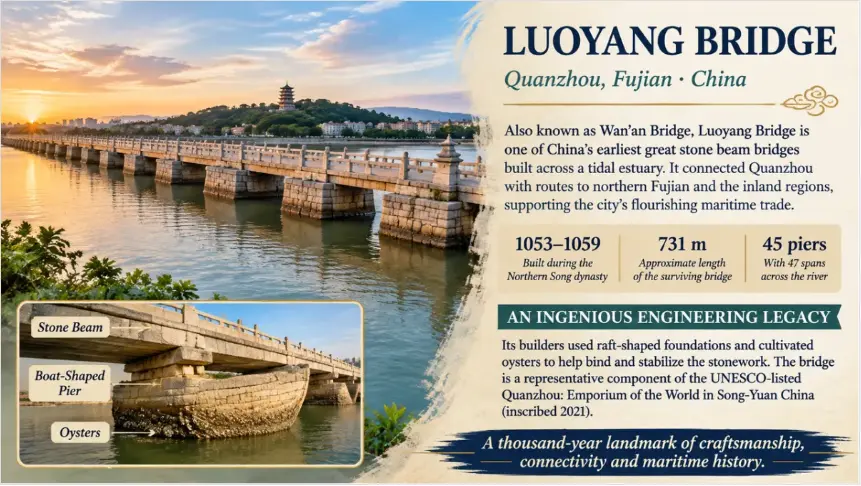
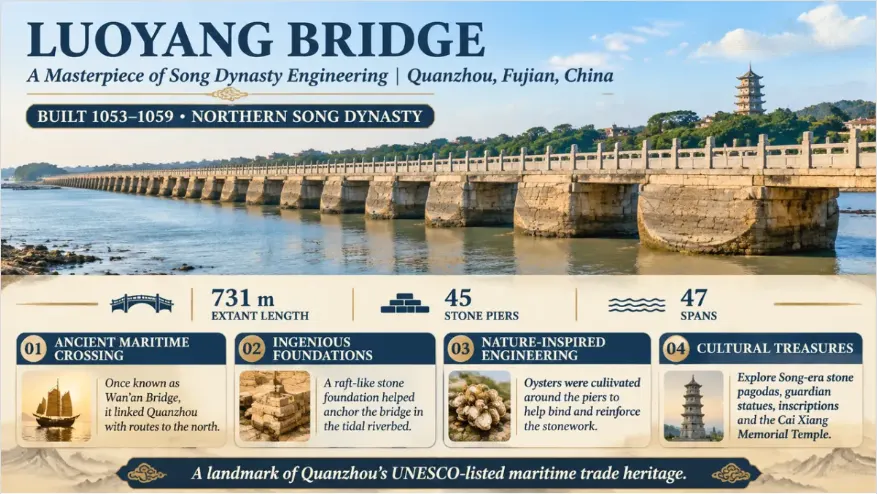
Luoyang Bridge is located at the mouth of the Luoyang River in Luojiang District, Quanzhou, about 10 km from the city center. It was first built in 1053 AD, the fifth year of the Huangyou reign of the Northern Song dynasty, and completed six years later. It has a history of nearly 1,000 years. Luoyang Bridge is China’s first cross-sea stone bridge and one of the four famous ancient bridges in China (the other three are Zhaozhou Bridge, Lugou Bridge, and Guangji Bridge).
The bridge takes its name from the Luoyang River it crosses. Historically, this was an important route from Quanzhou to Fuzhou and northern China. Before the bridge was built, people could only cross the river by ferry, and accidents were common during wind and waves. Cai Xiang, an official of the Northern Song dynasty, led the construction of this stone bridge and solved the transportation problem.
In 2021, Luoyang Bridge was inscribed as part of the UNESCO World Heritage site “Quanzhou: Emporium of the World in Song-Yuan China.”
2. Construction Techniques of Luoyang Bridge (Simplified)
The most amazing aspect of Luoyang Bridge is its construction technology. Nearly 1,000 years ago, without modern machinery, craftsmen used their wisdom to solve the problem of building a bridge on soft mud foundations. Here are two core techniques:
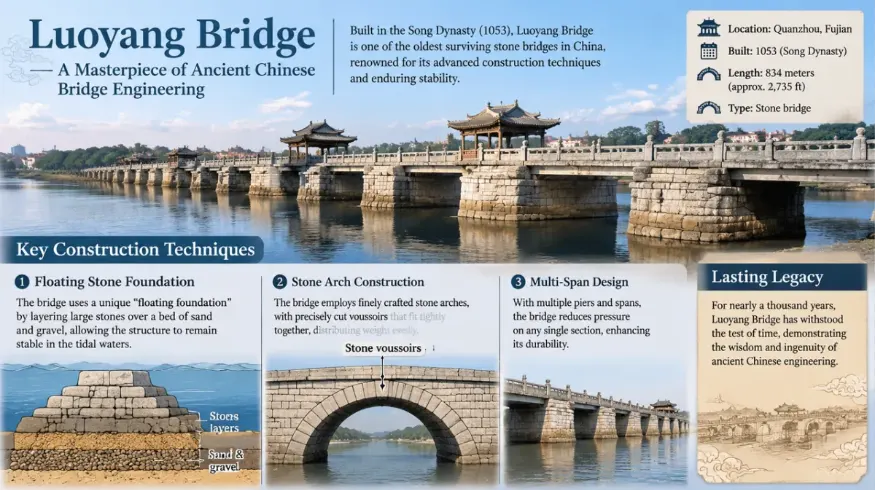
Raft Foundation
The seabed at the mouth of the Luoyang River is soft mud, and ordinary bridge piers would easily sink. Craftsmen invented the “raft foundation” – laying large amounts of stone on the seabed to form a low stone embankment across the riverbed, spreading the weight of the piers like a bamboo raft. This was an innovation in Chinese bridge history.
Oyster-Based Reinforcement
This is the most unique technique of Luoyang Bridge. Craftsmen cultivated oysters on the bridge piers. The mucus and shells secreted by oysters bonded the stones together, making the piers more solid. This method used biological characteristics to reinforce a structure – very rare in world bridge history. Today, you can still see traces of oyster shells on the piers.
In short: The raft foundation solved the problem of “piers sinking,” and oyster-based reinforcement solved the problem of “stones loosening.” These two techniques have allowed Luoyang Bridge to stand for nearly a thousand years.
3. Main Highlights of Luoyang Bridge
Bridge Body and Piers
Luoyang Bridge is about 834 meters long and 7 meters wide. The bridge deck is paved with huge granite slabs. The piers are boat-shaped to reduce water impact. The spaces between the piers allow boats to pass. You can walk on the bridge and experience the scale of this ancient structure.
Photo tip: Stand in the middle of the bridge and photograph the extending line of piers and deck. In the late afternoon, sunlight falls on the stone slabs – a beautiful sight.
Stone Pagodas
There are several stone pagodas on Luoyang Bridge, built during the Song dynasty. The pagodas are square or octagonal, with carvings of Buddhas and sutras on their surfaces. The most famous is a square stone pagoda in the middle section, about 5 meters tall. The pagodas decorate the bridge and also serve as blessings.
Stone Generals
At the bridgehead are two stone general statues, about 2 meters tall, wearing armor and holding weapons. The stone generals are guardian deities of the bridge, symbolizing protection for those who cross. Their carving style is simple and rustic — representative of Song dynasty stone carving.
Inscriptions
Several inscriptions from various dynasties are preserved near Luoyang Bridge, recording the bridge’s construction, repairs, and history. The most famous is the “Wan’an Bridge Record” stele written by Cai Xiang of the Northern Song dynasty, which records the bridge-building process. The calligraphy is exquisite and is important material for studying the history of Luoyang Bridge.
Cai Xiang Memorial Hall
The Cai Xiang Memorial Hall is located at the south end of the bridge. It was built to commemorate Cai Xiang, the Northern Song official who led the construction of Luoyang Bridge. Inside are a statue of Cai Xiang, steles, and historical materials. Cai Xiang was a famous politician, calligrapher, and tea expert of the Northern Song dynasty and once served as the prefect of Quanzhou.
- Admission: Free.
- Opening hours: 8:00–17:30.
Ancient Banyan Trees
Near the bridgehead are several ancient banyan trees, hundreds of years old. Their huge canopies block the sky, and aerial roots hang down — a great place to rest and take photos.
4. Visitor Information for Luoyang Bridge
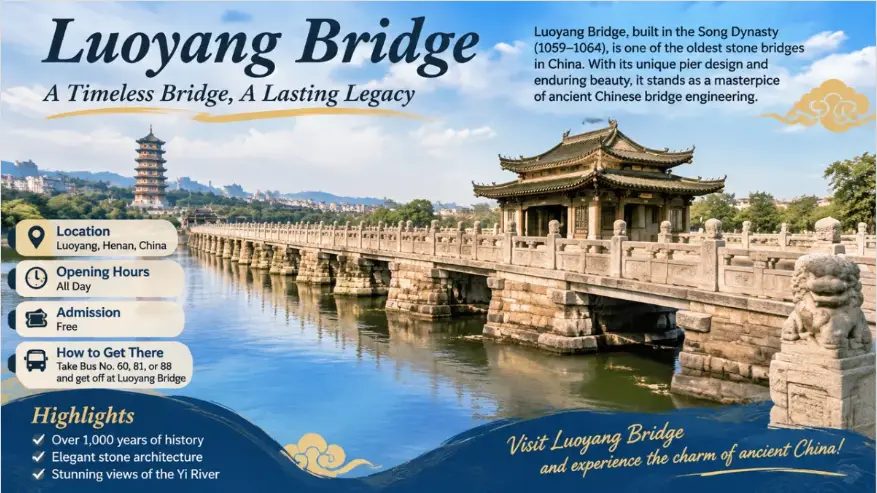
- Admission: Free.
- Opening hours: The bridge deck is open all day (you can walk on it anytime). Cai Xiang Memorial Hall is open 8:00–17:30.
- Recommended visit duration: 1–1.5 hours.
- Address: Luoyang Bridge, Luojiang District, Quanzhou.
- Best time: Late afternoon (16:00–18:00) – you can enjoy the sunset; the light is soft, and it is good for photography.
5. How to Get to Luoyang Bridge
Luoyang Bridge is in the northern part of Quanzhou city, with convenient transportation.
Bus
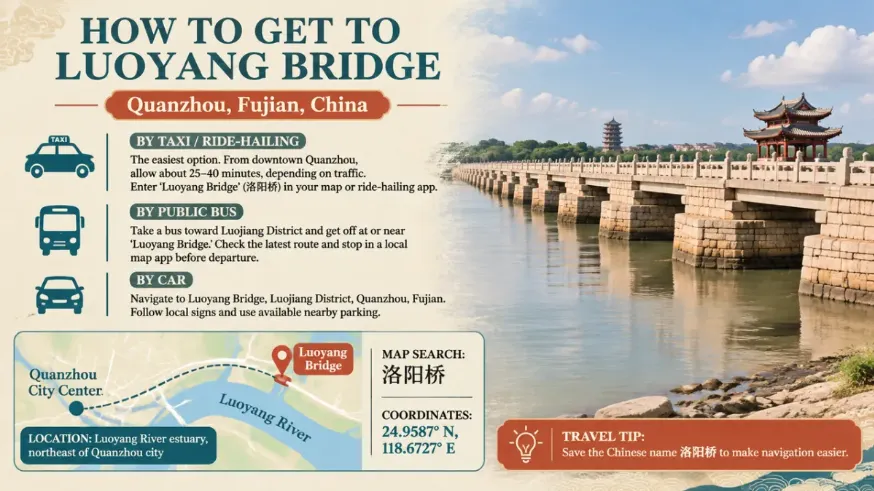
Take a bus to “Luoyang Bridge” station or “Qiaonan” station. Bus routes include 13, 19, K502, and others. Fare: 1–2 RMB. From Quanzhou city center, it takes about 40 minutes by bus.
Taxi / Ride-Hailing
Tell the driver “Luoyang Bridge.” From Quanzhou city center, it takes about 20 minutes and costs about 25–35 RMB. From Quanzhou Railway Station, it takes about 25 minutes and costs about 30–40 RMB.
Shared Bikes
Quanzhou has HelloBike and Meituan Bike. You can ride to the vicinity of Luoyang Bridge and then walk onto the bridge. From Quanzhou city center, cycling takes about 30–40 minutes.
Self-Driving
Navigate to “Luoyang Bridge” or “Cai Xiang Memorial Hall.” There is a parking lot near the bridgehead, with a parking fee of about 5–10 RMB.
6. Practical Tips for Visiting Luoyang Bridge
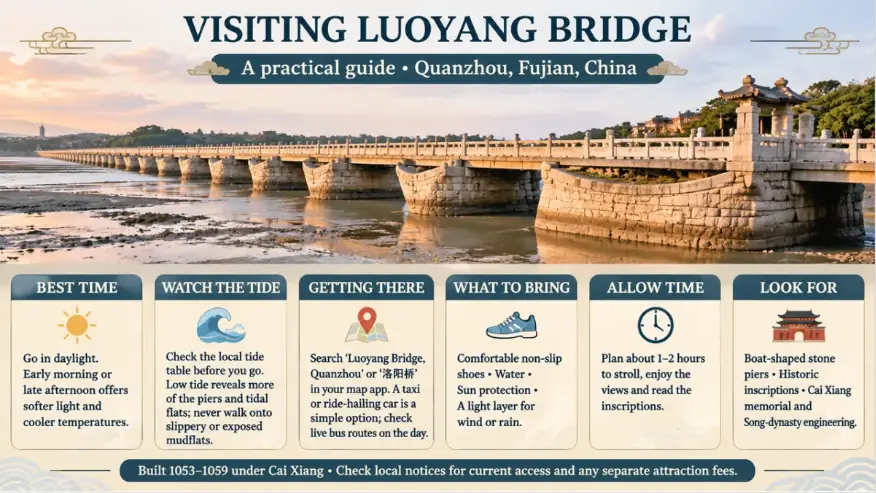
- Clothing: The bridge deck is paved with stone slabs. Wear comfortable sports shoes or flat shoes. Do not wear high heels.
- Sun protection: There is no shade on the bridge. Summer sunlight is strong. Bring sunscreen, a sun hat, and sunglasses.
- Weather: Stone slabs may be slippery on rainy days – walk carefully. The bridge may be closed during typhoons – check the weather in advance.
- Timing: Late afternoon is recommended for the sunset. Midday light is too harsh, and photos may be overexposed.
- Nearby: Near Luoyang Bridge are the Cai Xiang Memorial Hall and ancient banyan trees – you can visit them together. There are a few snack stalls at the south end, but not many choices. Bring water and snacks.
- Tides: The Luoyang River has tidal changes. At low tide, you can see the full structure of the piers; at high tide, the piers are partially submerged. Both scenes have their own character.
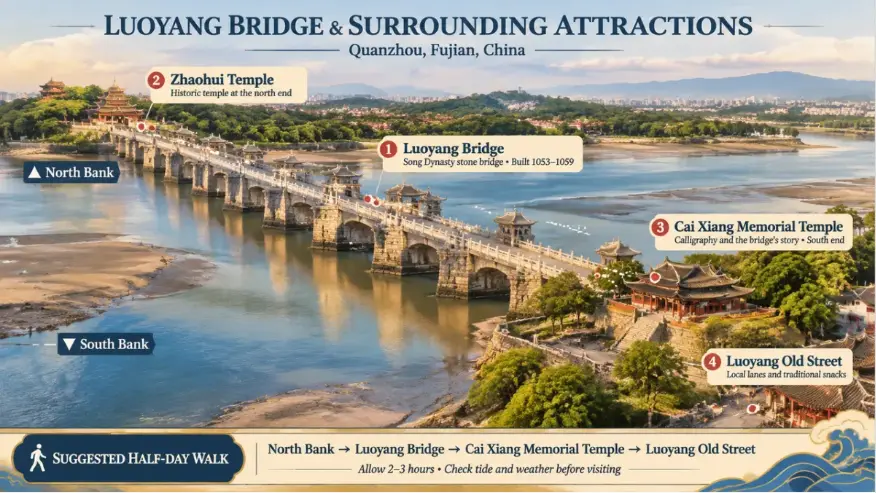
7. Combining Luoyang Bridge with Nearby Attractions
Luoyang Bridge is in the northern part of Quanzhou city and can be combined with the following attractions:
- Qingyuan Mountain: About 20 minutes by taxi from Luoyang Bridge. Visit Qingyuan Mountain in the morning and Luoyang Bridge in the afternoon for sunset.
- Kaiyuan Temple and West Street: About a 25-minute taxi ride from Luoyang Bridge. You can visit Kaiyuan Temple and West Street in the morning and Luoyang Bridge in the afternoon.
- Quanzhou Maritime Museum: About 20 minutes by taxi from Luoyang Bridge. Learn about Quanzhou’s history as a Maritime Silk Road port.
- Xunpu Village: About 25 minutes by taxi from Luoyang Bridge. Experience the Zanhuawei floral headdress and oyster-shell houses.
Suggested route: Morning – Kaiyuan Temple and West Street; lunch on West Street; afternoon – Qingjing Mosque and Guanyue Temple; late afternoon – sunset at Luoyang Bridge. This is the classic one-day route in Quanzhou’s ancient city.
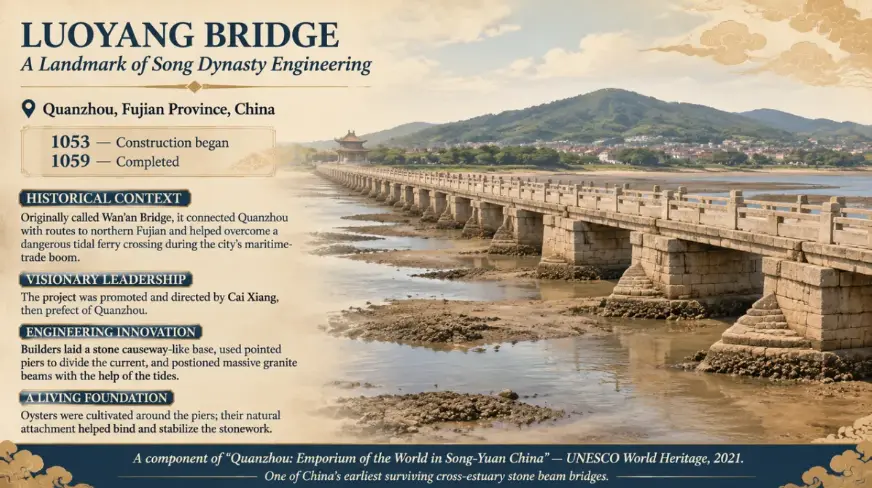
8. Luoyang Bridge History (Simplified)
- Northern Song dynasty (1053–1059): Cai Xiang led the construction of Luoyang Bridge, completed in six years.
- Song to Qing dynasties: The bridge was damaged by wind, waves, and earthquakes many times, and officials and locals repaired it repeatedly.
- 1930s: A major repair was carried out, and part of the bridge deck was changed to concrete.
- 1988: Listed as a Major Historical and Cultural Site Protected at the National Level in China.
- 2021: Inscribed as part of the UNESCO World Heritage site in Quanzhou.
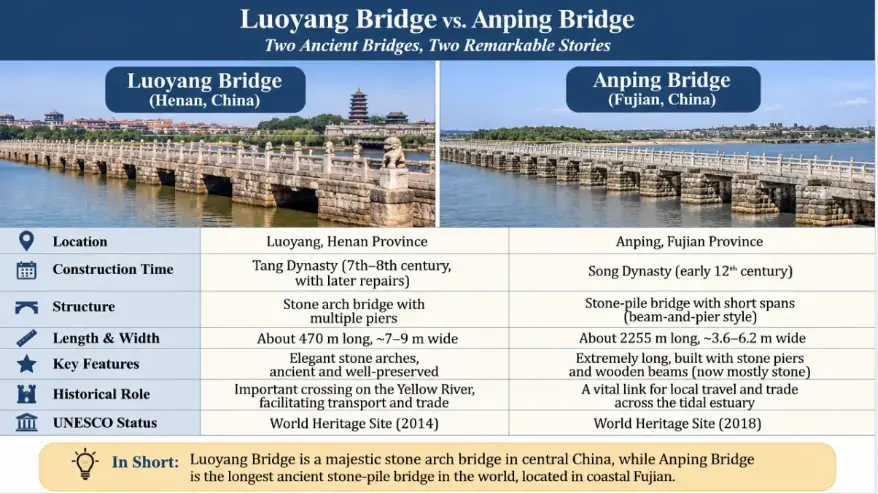
9. Difference Between Luoyang Bridge and Anping Bridge
Quanzhou has two famous ancient stone bridges: Luoyang Bridge and Anping Bridge. Tourists often confuse them.
- Luoyang Bridge: Located in the northern part of Quanzhou city, built in the Northern Song dynasty, about 834 meters long, China’s first cross-sea stone bridge. Known for its raft foundation and oyster-based reinforcement techniques.
- Anping Bridge: Located in Anhai Town, Jinjiang City, built in the Southern Song dynasty, about 2,255 meters long, the longest surviving ancient stone bridge in China. Known for its astonishing length – called “the longest bridge under heaven.”
Advice: If you have limited time, prioritize Luoyang Bridge (closer to the city center, more convenient transport). If you are deeply interested in ancient bridges, visit both.
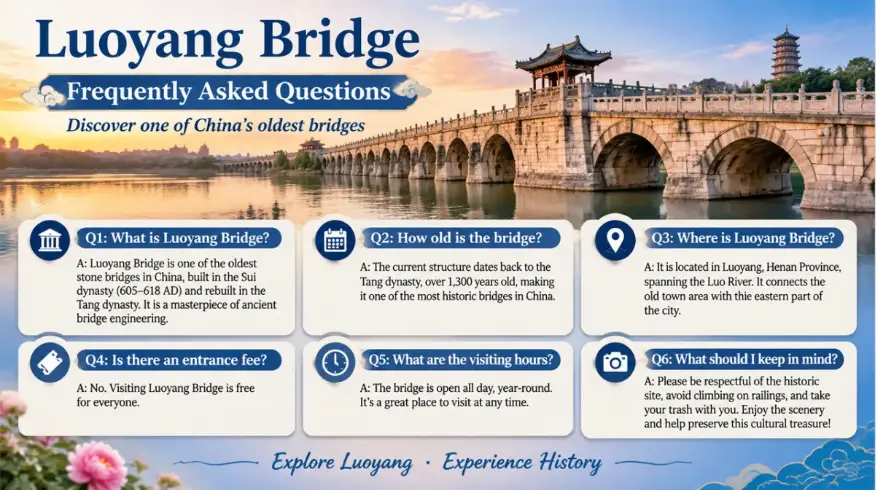
Frequently Asked Questions (FAQ)
Q: Does Luoyang Bridge require a ticket?
A: No. Luoyang Bridge is free and open all day for walking. The Cai Xiang Memorial Hall is also free.
Q: What are the opening hours of Luoyang Bridge?
A: The bridge deck is open all day. The Cai Xiang Memorial Hall is open 8:00–17:30.
Q: Is Luoyang Bridge far from Quanzhou city center?
A: Not far. It is about 10 km from the city center – about 20 minutes by taxi or 40 minutes by bus.
Q: Can I walk on Luoyang Bridge?
A: Yes. Luoyang Bridge is a pedestrian bridge, and you can walk freely on it. The deck is stone slabs – wear comfortable shoes.
Q: What is special about Luoyang Bridge?
A: Luoyang Bridge is China’s first cross-sea stone bridge and uses two unique techniques: the raft foundation and oyster-based reinforcement. Oyster-based reinforcement uses oyster shells to bond stones and strengthen the piers – very rare in world bridge history.
Q: Which is more worth visiting – Luoyang Bridge or Anping Bridge?
A: Both are worth visiting, but they have different styles. Luoyang Bridge is closer to the city and has more unique techniques. Anping Bridge is longer and larger in scale. If time is limited, prioritize Luoyang Bridge.
Q: Is Luoyang Bridge suitable for children?
A: Yes. The bridge deck is flat, and children can walk safely. However, there is no shade on the bridge – pay attention to sun protection in summer. Watch children near areas without railings.
Q: Is Luoyang Bridge suitable for elderly visitors?
A: Yes. The bridge deck is flat and suitable for walking. However, the bridge is about 834 meters long, and walking the full round trip requires some energy. Elderly visitors can take a short walk near the bridgehead and do not need to walk the entire length.
Q: How do I get to Luoyang Bridge from Xiamen?
A: Take a high-speed train from Xiamen to Quanzhou Station (about 30 minutes), then take a taxi to Luoyang Bridge (about 25 minutes, 30–40 RMB). You can also take a bus.
Q: Are there restaurants near Luoyang Bridge?
A: There are a few snack stalls and restaurants at the south end, but not many choices. It is recommended to eat in Quanzhou city before going, or bring water and snacks.
Q: When is the best time to photograph Luoyang Bridge?
A: Late afternoon (16:00–18:00) has soft light and is good for sunset photos. Morning light is also good, with fewer tourists. Midday light is too strong and may overexpose photos.
Q: Does Luoyang Bridge have English guides?
A: Luoyang Bridge does not have official English-speaking guides. There are Chinese-English introduction boards at the bridgehead. Use a translation app or read English materials in advance.
Related Reading:
- Qingjing Mosque Quanzhou: China’s Oldest Islamic Temple Guide
- Does Quanzhou Have English-Speaking Tour Guides? | Full Guide
- Quanzhou Attractions: UNESCO Sites & Hidden Gems for Foreigners
- How Many Days in Quanzhou? 1, 2, 3, & 4-Day Itinerary Guide
- Quanzhou vs Xiamen: Which City Should You Visit? | Full Comparison
- Quanzhou Travel Guide: Maritime Silk Road, Temples & Food
- How to Get from Zhangzhou Ancient City to Tulou: Transport Guide
- Zhangzhou Attractions Guide: Tulou, Dongshan Island, Volcano & Ancient Town
- 2026 Xiamen Transportation Guide: Metro, Bus, Ferry & Taxi Tips for Foreigners
- What is Xiamen Famous For? | Gulangyu World Heritage, Food, Beaches & SEZ