Kaiyuan Temple Quanzhou: History, Twin Pagodas & Visitor Guide
If you are planning a trip to Quanzhou, Kaiyuan Temple should be your first stop. Located in the city center, Kaiyuan Temple was first built in the Tang dynasty and is one of Fujian’s largest Buddhist temples. It is also an important part of the UNESCO World Heritage site “Quanzhou: Emporium of the World in Song-Yuan China.” The temple’s most famous feature is its two Song-dynasty stone pagodas, the Twin Pagodas, about 48 meters tall and the tallest stone pagodas in China. This guide covers Kaiyuan Temple’s history, highlights, visitor information, transportation, and practical tips to help foreign travelers plan easily.
1. Kaiyuan Temple Overview
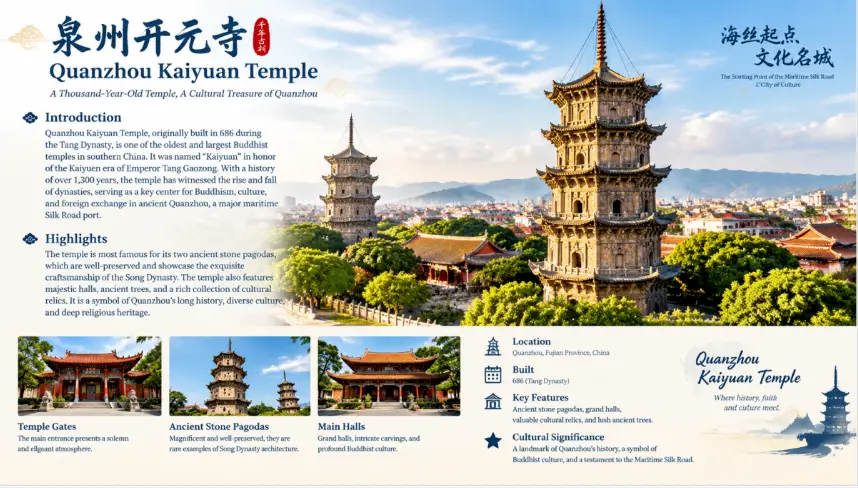
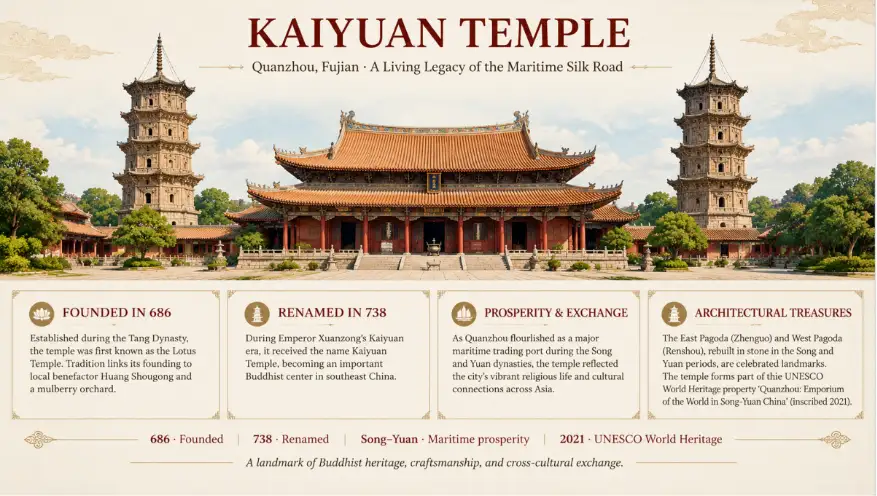
Kaiyuan Temple is located at No. 176 West Street, Licheng District, Quanzhou. It was first built in the Tang dynasty (686 AD). It is one of the largest Buddhist temples in Fujian, covering about 78,000 square meters. The name “Kaiyuan” comes from Emperor Xuanzong of the Tang, who in 738 AD ordered each prefecture to build a temple named “Kaiyuan.” Quanzhou’s Kaiyuan Temple was one of them.
Kaiyuan Temple reached its peak during the Song and Yuan dynasties. At that time, Quanzhou was one of the busiest ports in the world, and the temple received support from local officials, merchants, and sea traders. The temple preserves many buildings, carvings, and relics from the Song, Yuan, Ming, and Qing dynasties. In 1982, it was listed as a Major Historical and Cultural Site Protected at the National Level. In 2021, it became part of the UNESCO World Heritage site “Quanzhou: Emporium of the World in Song-Yuan China.”
2. Main Highlights of Kaiyuan Temple
The Twin Pagodas (Zhenguo Pagoda and Renshou Pagoda)
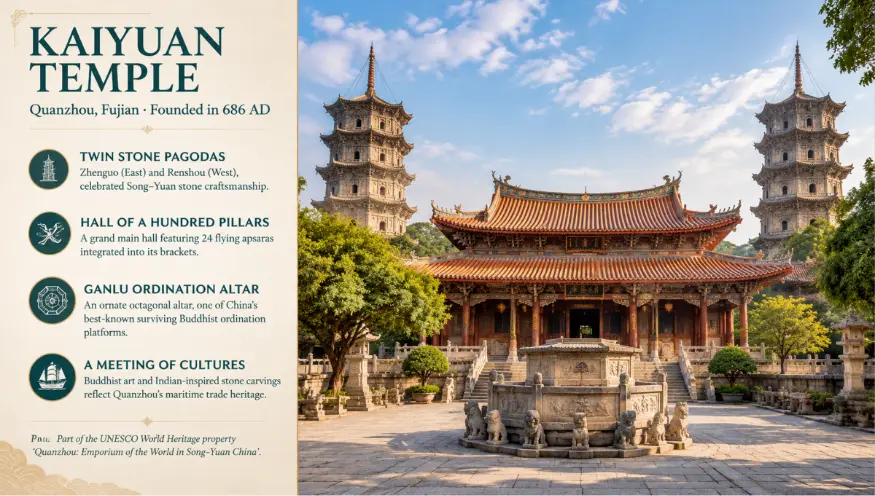
The Twin Pagodas are Kaiyuan Temple’s most famous landmark and a symbol of Quanzhou. They stand on the east and west sides of the temple:
- East Pagoda (Zhenguo Pagoda): Built during the Southern Song dynasty (1238–1250), about 48.24 meters tall.
- West Pagoda (Renshou Pagoda): Built during the Southern Song dynasty (1228–1237), about 44.06 meters tall.
Both are five-story, octagonal stone pagodas made entirely of granite. The pagoda surfaces are carved with Buddhas, bodhisattvas, arhats, and Buddhist stories – 80 reliefs in total. These stone pagodas have survived centuries of earthquakes and typhoons and remain intact. You can walk around the base, but you cannot climb the pagodas.
Photo tip: West Street is the best place to photograph the Twin Pagodas. In the late afternoon, sunlight falls on the stone towers – a beautiful sight.
Mahavira Hall
The Mahavira Hall is the main building of Kaiyuan Temple, built in the Ming dynasty. Inside are five large Buddhas – a rare arrangement in Chinese Buddhist temples. The hall’s columns are distinctive: two of them are carved with Hindu mythological stories, which is very rare in a Chinese Buddhist temple and reflects Quanzhou’s history of multicultural coexistence.
Note: Photography is not allowed inside the hall. Please follow the temple rules.
Ancient Banyan Trees
Kaiyuan Temple has several ancient banyan trees over a thousand years old. Their huge canopies block the sky, and aerial roots hang down, creating a unique scene. The most famous one stands in front of the Mahavira Hall and is called the “Thousand-Year Ancient Banyan.” There are stone benches underneath for resting.
Ganlu Ordination Platform
The Ganlu Ordination Platform is one of the three surviving ordination platforms in China (the other two are in Beijing and Hangzhou). It is where Buddhist followers receive ordination. The building is finely decorated with complex wood carvings and a coffered ceiling. It is usually not open to the public, but you can view it from outside.
Quanzhou Bay Ancient Ship Exhibition Hall
Inside Kaiyuan Temple is a small museum displaying a Song-dynasty ship unearthed in Quanzhou Bay in 1974. The ship is important evidence of Quanzhou’s role as a port on the Maritime Silk Road. The exhibition hall is free and worth a visit.
Buddhist Sutra Library
The Sutra Library houses many Buddhist scriptures and relics, including sutras from the Song, Yuan, and Ming dynasties. It is usually not open to the public, but the building itself is worth seeing.
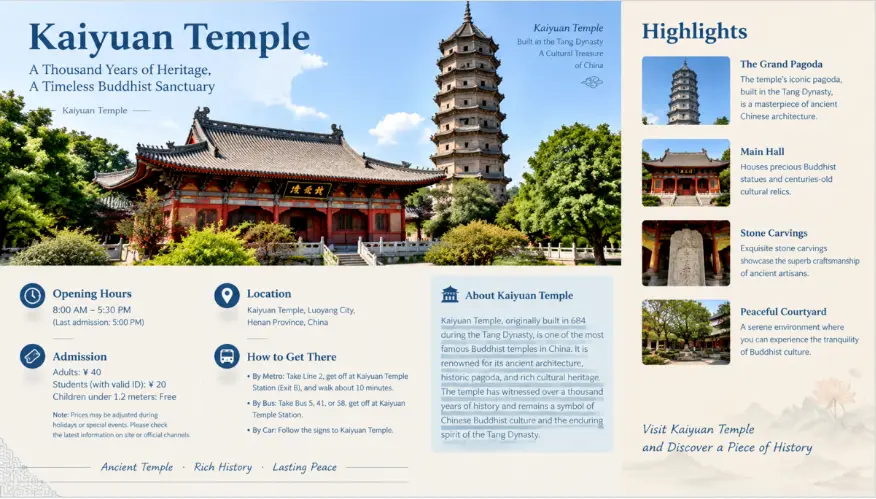
3. Visitor Information for Kaiyuan Temple
- Admission: Free.
- Opening hours: 8:00–17:30 (open all year; enter before 16:30 if possible).
- Recommended visit duration: 1.5–2 hours.
- Reservation: Kaiyuan Temple is currently free and usually does not require a reservation. During holidays or special events, a reservation via the WeChat public account may be required. Check the latest information before you go.
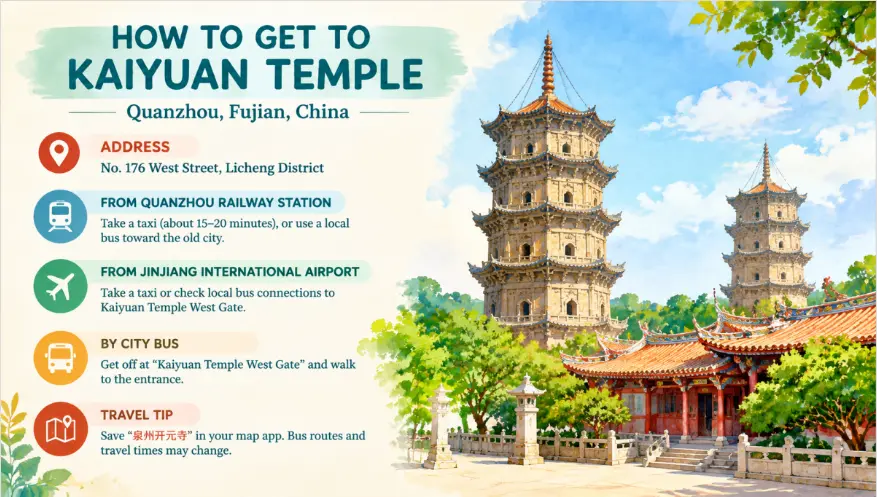
- Address: No. 176 West Street, Licheng District, Quanzhou.
4. How to Get to Kaiyuan Temple
Kaiyuan Temple is in the center of Quanzhou, with very convenient transportation.
Bus
Take a bus to “Kaiyuan Temple” station or “West Street” station. Bus routes include 2, 6, 26, 40, K205, and others. Fare: 1–2 RMB.
Taxi / Ride-Hailing
Tell the driver “Kaiyuan Temple” or “West Street.” From Quanzhou Railway Station, it takes about 20 minutes and costs about 25–30 RMB. From most hotels in Quanzhou city, it costs about 10–15 RMB.
Shared Bikes
Quanzhou has HelloBike and Meituan Bike. You can ride to the vicinity of Kaiyuan Temple in the ancient city and then walk in.
Walking
If you stay in Quanzhou’s ancient city area (near West Street or the Clock Tower), you can walk to Kaiyuan Temple.
5. Practical Tips for Visiting Kaiyuan Temple
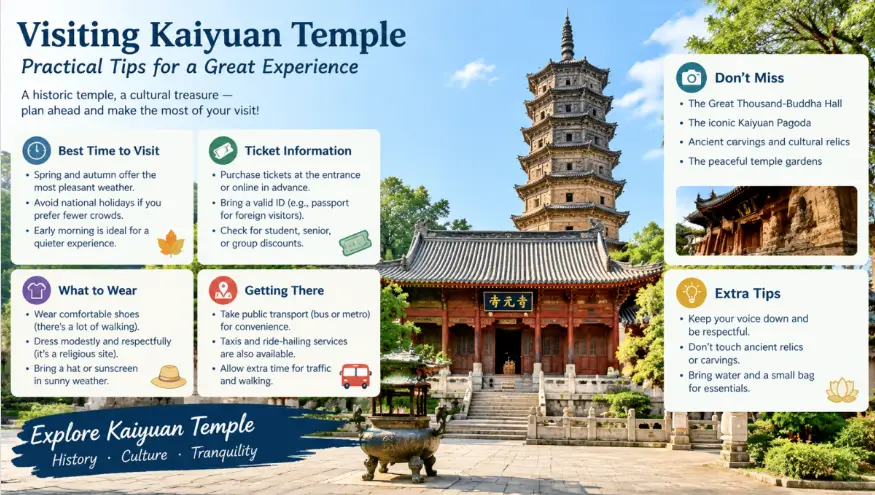
- Clothing: Kaiyuan Temple is a religious site. Avoid shorts, short skirts, or overly revealing clothes. Wear long pants or a long skirt and cover your shoulders.
- Remove your hat: Take off your hat when entering halls.
- Keep quiet: Monks and worshippers are present. Keep your voice down and avoid loud talking.
- Photography: Photography is usually not allowed inside halls. The pagodas and exterior buildings can be photographed. Do not photograph monks or worshippers.
- Incense: If you wish to burn incense, you can buy incense sticks inside the temple (about 5–10 RMB) and light them in designated areas. Be careful with fire safety.
- Timing: Visit in the morning or late afternoon to avoid midday heat and tour group peaks.
- Nearby: Kaiyuan Temple is right on West Street. After visiting, you can stroll along West Street and try local snacks such as misua paste, meat zongzi, and four-fruit soup.
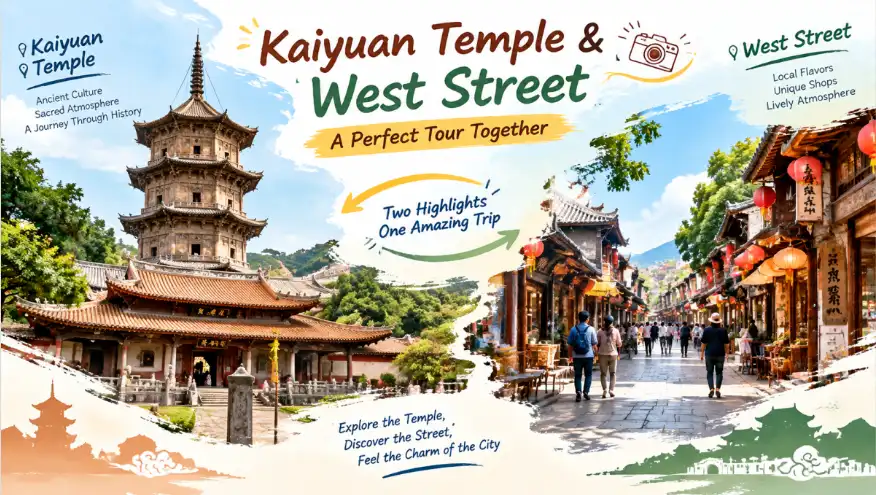
6. Combining Kaiyuan Temple with West Street
The entrance to Kaiyuan Temple is on West Street. West Street is Quanzhou’s oldest street, preserving many Minnan red-brick buildings and snack shops. Suggested route:
- Morning: Visit Kaiyuan Temple (1.5–2 hours).
- After leaving the temple, walk east along West Street and explore snack shops and craft stores (1–2 hours).
- Walk to the Clock Tower and take photos.
- Have lunch near the Clock Tower (recommended: misua paste, meat zongzi, beef soup).
This half-day plan lets you experience both Kaiyuan Temple’s history and West Street’s local life.
7. Kaiyuan Temple History (Simplified)
- Tang dynasty (686 AD): The temple was first built and named “Lotus Temple.”
- Tang dynasty (738 AD): Emperor Xuanzong ordered it renamed “Kaiyuan Temple.”
- Song dynasty (13th century): The Twin Pagodas were completed, and the temple reached its peak.
- Yuan dynasty: Quanzhou became a major world port, and Kaiyuan Temple received substantial support, becoming a center of multicultural exchange.
- Ming and Qing dynasties: The temple was repaired many times and preserved to this day.
- 1982: Listed as a Major Historical and Cultural Site Protected at the National Level.
- 2021: Inscribed as part of the UNESCO World Heritage site in Quanzhou.
Frequently Asked Questions (FAQ)
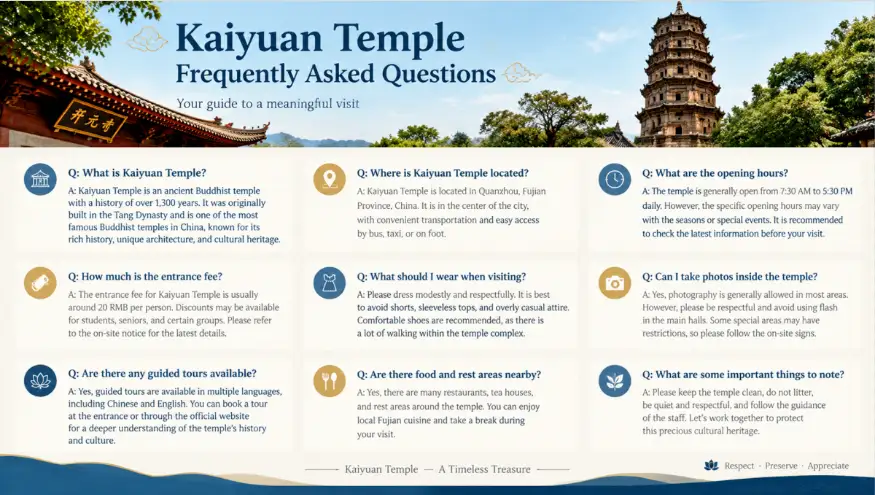
Q: Does Kaiyuan Temple require a ticket?
A: No. Kaiyuan Temple is free and open to the public.
Q: What are the opening hours of Kaiyuan Temple?
A: 8:00–17:30. Enter before 16:30 to allow enough time for your visit.
Q: Can I climb the Twin Pagodas?
A: No. The Twin Pagodas are protected cultural relics and are not open for climbing. You can walk around the base and take photos.
Q: Does Kaiyuan Temple have English guides?
A: Kaiyuan Temple does not have official English-speaking guides. Signs are in Chinese and English, and major halls have English introduction boards. Use a translation app or read English materials in advance.
Q: Do I need to make a reservation to visit Kaiyuan Temple?
A: Usually not. However, during holidays or special events, a reservation via the WeChat public account may be required. Check the latest information before you go.
Q: Is Kaiyuan Temple suitable for children?
A: Yes. The temple has spacious areas, and children can walk safely. But remind children to keep quiet and not climb on cultural relics.
Q: Can I take photos at Kaiyuan Temple?
A: The exterior buildings and stone pagodas can be photographed. Photography is usually not allowed inside halls. Do not photograph monks or worshippers.
Q: What food is near Kaiyuan Temple?
A: Kaiyuan Temple is on West Street. There are many snack shops on West Street. Recommended: misua paste, meat zongzi, four-fruit soup, beef soup, and runbing rolls.
Q: How do I get to Kaiyuan Temple from Xiamen?
A: Take a high-speed train from Xiamen to Quanzhou Station (about 30 minutes), then take a taxi to Kaiyuan Temple (about 20 minutes, 25–30 RMB). You can also take a bus.
Q: How should I combine Kaiyuan Temple with other Quanzhou attractions?
A: Suggested: morning – Kaiyuan Temple and West Street; afternoon – Qingjing Mosque, Guanyue Temple, and Tianhou Temple; late afternoon – sunset at Luoyang Bridge. This is the classic one-day route in Quanzhou’s ancient city.
Related Reading:
- Does Quanzhou Have English-Speaking Tour Guides? | Full Guide
- Quanzhou Attractions: UNESCO Sites & Hidden Gems for Foreigners
- How Many Days in Quanzhou? 1, 2, 3, & 4-Day Itinerary Guide
- Quanzhou vs Xiamen: Which City Should You Visit? | Full Comparison
- Quanzhou Travel Guide: Maritime Silk Road, Temples & Food
- How to Get from Zhangzhou Ancient City to Tulou: Transport Guide
- Does Zhangzhou Ancient City Need Tickets? Free Entry & Tips
- How to Get from Zhangzhou Ancient City to Tulou: Transport Guide
- Zhangzhou Ancient City vs. Xiamen Zhongshan Road: Which One Is Worth Visiting?
- Zhangzhou Food Guide: Must-Try Dishes & Where to Eat
- Zhangzhou Travel Guide: Tulou, Dongshan Island & Local Food
- 2026 Xiamen Transportation Guide: Metro, Bus, Ferry & Taxi Tips for Foreigners
- What Is Xiamen Famous For? 2026 Travel Guide to Top Attractions & Food
- Gulangyu Island Travel Guide: Ferry Tickets, Attractions & Tips 2026
- Xiamen Travel Guide 2026: Top 10 Attractions + 3-Day Itinerary