Qingjing Mosque Quanzhou: China’s Oldest Islamic Temple Guide
If you are a Muslim traveler or interested in China’s religious history, Qingjing Mosque in Quanzhou is a site you should not miss. Located in the city center of Quanzhou, Qingjing Mosque was first built in the Northern Song dynasty. It is one of the oldest surviving Islamic mosques in China and an important part of the UNESCO World Heritage site “Quanzhou: Emporium of the World in Song-Yuan China.” The mosque reflects Quanzhou’s history as a major global maritime trade center during the Song and Yuan dynasties and preserves the story of Arab and Persian merchants who lived and traded here. This guide covers Qingjing Mosque’s history, highlights, visitor information, transportation, and practical tips.
1. Qingjing Mosque Overview
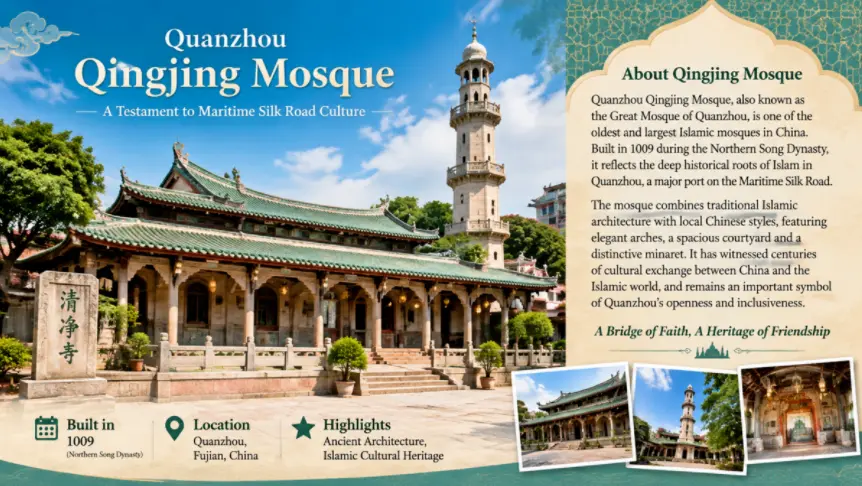
Qingjing Mosque is located at No. 108 Tumen Street, Licheng District, Quanzhou. It was first built in 1009 AD, during the Northern Song dynasty. It is one of the oldest surviving Islamic mosques in China and an important part of Quanzhou’s World Heritage site. Its Arabic name is Ashab Mosque, meaning “Mosque of the Companions.”
During the Song and Yuan dynasties, Quanzhou was one of the busiest ports in the world. Many Muslim merchants from Arabia, Persia, and Southeast Asia lived and traded here. Qingjing Mosque was built by these Muslim merchants as a place of worship. The mosque has been rebuilt and repaired several times. The main surviving structures include the entrance gatehouse, the prayer hall, and the ruins of the minaret.
In 2021, Qingjing Mosque was inscribed as part of the UNESCO World Heritage site “Quanzhou: Emporium of the World in Song-Yuan China.”
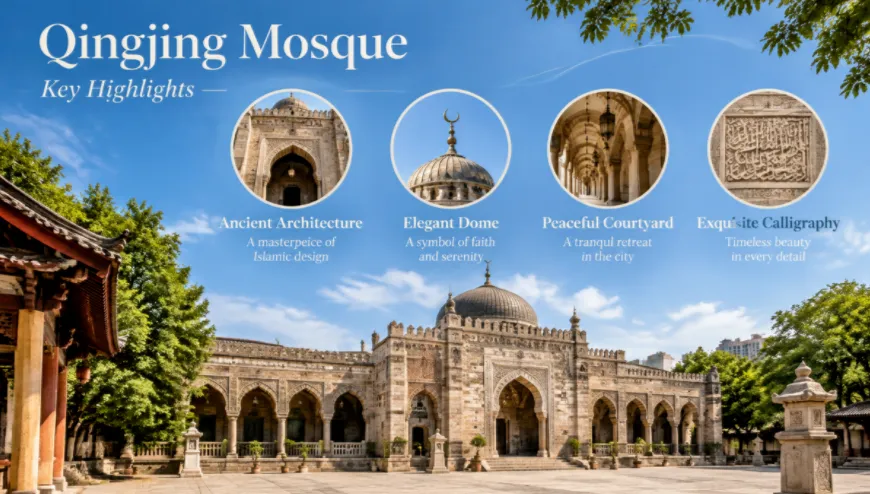
2. Main Highlights of Qingjing Mosque
The Entrance Gatehouse
The entrance gatehouse is the most striking structure at Qingjing Mosque. It is built of granite, about 20 meters high and 4.5 meters wide. It follows a typical Islamic architectural style, with a pointed arch doorway and intricate stone carvings. At the top of the gatehouse are the remains of the minaret, where the muezzin once called Muslims to prayer.
The stone carvings are very fine, including Arabic calligraphy, geometric patterns, and floral designs. You can see Quranic verses in Arabic carved above the doorway. These carvings are still clearly visible after hundreds of years.
Photo tip: The gatehouse is the most photogenic part of Qingjing Mosque, especially when sunlight falls on the stone carvings. Morning or late afternoon light is best.
The Prayer Hall
The prayer hall is where Muslims perform their prayers. Qingjing Mosque’s prayer hall retains its original stone walls and arched windows. Inside, on the west wall facing Mecca, there is a mihrab – a niche that indicates the direction of prayer. Carpets are laid on the floor for Muslims to kneel on during prayer.
Note: The prayer hall is a religious space. Non-Muslims may enter to visit, but please keep quiet and do not disturb Muslims who are praying. Photography is not allowed inside the prayer hall.
The Minaret Ruins
A minaret is a tall tower used to call worshippers to prayer. The minaret of Qingjing Mosque was damaged and rebuilt several times in history. The surviving ruins are located at the top of the entrance gatehouse. You can look up and see the remaining stone structure. This is one of the earliest surviving minaret ruins in China.
Ming Dynasty Stone Stele
Qingjing Mosque preserves several Ming dynasty stone steles. The most important is the imperial edict stele issued by Emperor Chengzu (Zhu Di) in 1407, the fifth year of the Yongle reign. The stele records an imperial order requiring local officials to protect the mosque and Muslim merchants. It is an important artifact for studying the history of Islam in China.
Muslim Cemetery
Near Qingjing Mosque is a Muslim cemetery where Arab and Persian merchants who died in Quanzhou during the Song and Yuan dynasties were buried. The cemetery contains ancient Arabic tombstones and is evidence of Quanzhou’s multicultural history. The cemetery is usually not open to the public, but you can view it from the outside.
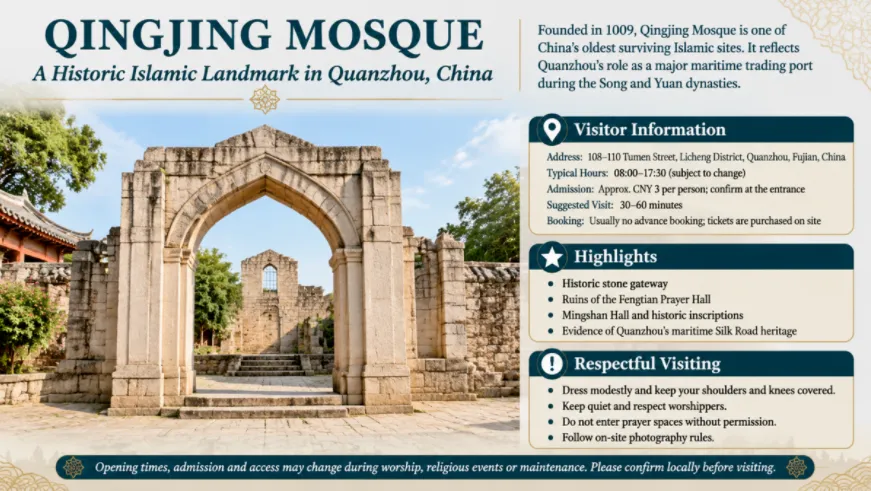
3. Visitor Information for Qingjing Mosque
- Admission: About 3 RMB (a symbolic fee).
- Opening hours: 8:00–17:30, open all year.
- Recommended visit duration: 40 minutes to 1 hour.
- Address: No. 108 Tumen Street, Licheng District, Quanzhou.
- Dress code: Please dress modestly. Female visitors are advised to cover their hair (bring a scarf). Avoid shorts, short skirts, or overly revealing clothing. Male visitors should avoid tank tops and shorts. Remove your shoes before entering the prayer hall.
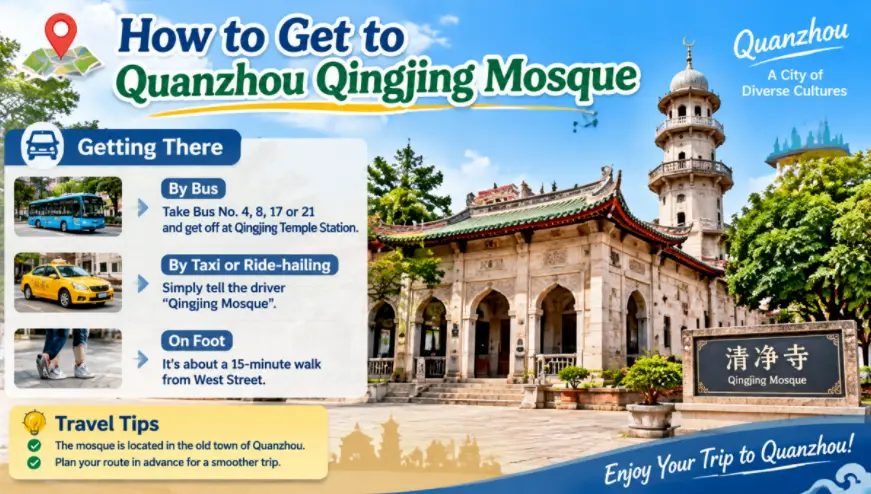
4. How to Get to Qingjing Mosque
Qingjing Mosque is in the center of Quanzhou, with very convenient transportation.
Bus
Take a bus to “Qingjing Mosque” station or “Tumen Street” station. Bus routes include 2, 6, 26, 40, and others. Fare: 1–2 RMB.
Taxi / Ride-Hailing
Tell the driver “Qingjing Mosque” or “Tumen Street.” From Quanzhou Railway Station, it takes about 20 minutes and costs about 25–30 RMB. From most hotels in Quanzhou city, it costs about 10–15 RMB.
Walking
If you stay in Quanzhou’s ancient city area (near West Street or the Clock Tower), it is about a 10–15 minute walk to Qingjing Mosque.
Shared Bikes
Quanzhou has HelloBike and Meituan Bike. You can ride to the vicinity of Qingjing Mosque in the ancient city and then walk in.
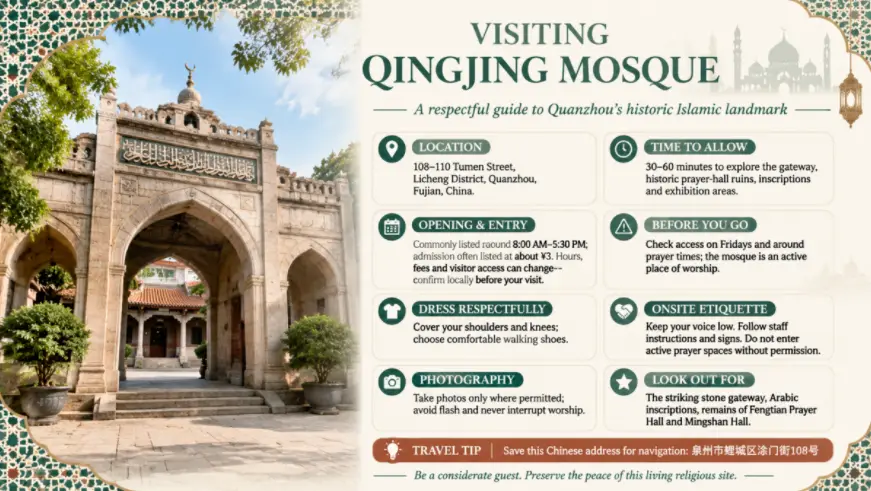
5. Practical Tips for Visiting Qingjing Mosque
- Dress modestly: As mentioned above, please dress appropriately. For female visitors, covering your hair is a sign of respect in a religious place.
- Remove your shoes: Shoes must be removed before entering the prayer hall. Wear shoes that are easy to take off and put on.
- Keep quiet: The prayer hall is a place of worship. Please keep your voice down and avoid loud talking.
- Photography: The exterior of the buildings can be photographed. Photography is not allowed inside the prayer hall. Do not photograph Muslims while they are praying.
- Prayer times: Muslims pray five times a day (dawn, noon, afternoon, sunset, and night). The prayer hall is used during these times. Non-Muslims should avoid entering the prayer hall during prayer times. You can wait outside or visit other areas first.
- No incense: Qingjing Mosque is a mosque, not a Buddhist or Taoist temple. Do not burn incense. Please respect Islamic customs.
- Nearby: Qingjing Mosque is on Tumen Street. Nearby are Guanyue Temple (a Taoist temple) and the Quanzhou Confucian Temple. You can visit them on the same day and experience Quanzhou’s diverse religious culture.

6. Combining Qingjing Mosque with Nearby Attractions
Qingjing Mosque is located in the heart of Quanzhou’s ancient city. Several important attractions nearby can be combined in one visit:
- Guanyue Temple: Located next door to Qingjing Mosque, it is Quanzhou’s most popular Taoist temple. It is a 1-minute walk away. On the same street, a mosque and a Taoist temple stand side by side, a unique sight.
- Quanzhou Confucian Temple: About a 5-minute walk from Qingjing Mosque. It is one of the largest Confucian temple complexes in Fujian and is free to enter.
- West Street and Kaiyuan Temple: About a 15-minute walk from Qingjing Mosque.
Suggested route: Morning – visit Kaiyuan Temple and West Street. Lunch – eat on West Street. Afternoon – visit Qingjing Mosque, Guanyue Temple, and the Confucian Temple. This half-day to full-day plan lets you experience Quanzhou’s diverse religious culture.
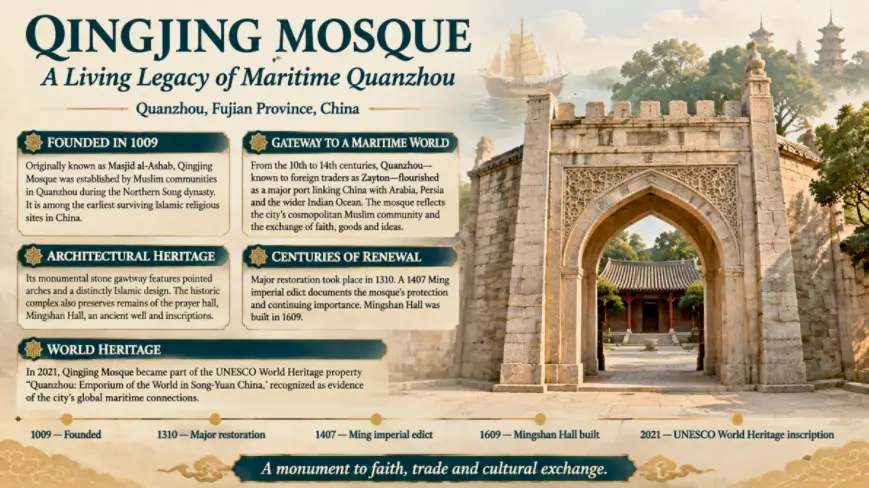
7. Qingjing Mosque History (Simplified)
- Northern Song dynasty (1009 AD): The mosque was first built with funding from Arab Muslim merchants.
- Yuan dynasty: Quanzhou became a major world port. Qingjing Mosque was expanded and repaired, becoming one of the most important Islamic mosques in China at the time.
- Ming dynasty: Emperor Chengzu (Zhu Di) issued an imperial edict stele protecting the mosque and Muslim merchants. The mosque was repaired several times.
- Qing dynasty: Some buildings were damaged, but the entrance gatehouse and prayer hall survived.
- 1988: Listed as a Major Historical and Cultural Site Protected at the National Level in China.
- 2021: Inscribed as part of the UNESCO World Heritage site in Quanzhou.
8. Other Religious Sites in Quanzhou
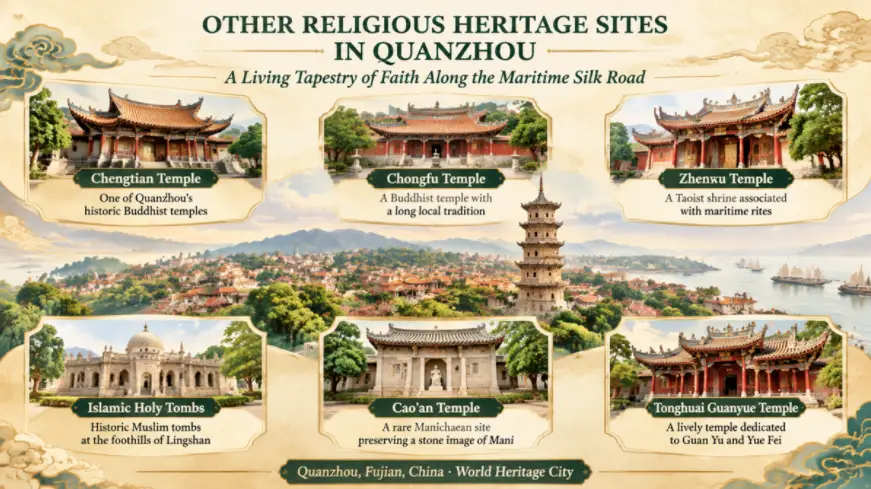
If you are interested in religious history, Quanzhou has other religious sites worth visiting:
- Kaiyuan Temple: The largest Buddhist temple in Fujian, with the Song-dynasty Twin Pagodas.
- Guanyue Temple: Quanzhou’s most popular Taoist temple.
- Tianhou Temple: Quanzhou’s largest Mazu temple.
- Quanzhou Maritime Museum: Displays Quanzhou’s history as a Maritime Silk Road port, including tombstones and artifacts of Muslim merchants.
- Caoyan: The world’s only surviving Manichaean temple site, located in Jinjiang City.
Quanzhou is called a “Museum of World Religions” because it preserves traces of Buddhism, Taoism, Islam, Christianity, Hinduism, Manichaeism, and other religions. Qingjing Mosque is the most important Islamic site among them.
Frequently Asked Questions (FAQ)
Q: Does Qingjing Mosque require a ticket?
A: Yes. The ticket is about 3 RMB, a symbolic fee.
Q: What are the opening hours of Qingjing Mosque?
A: 8:00–17:30, open all year.
Q: Can non-Muslims enter Qingjing Mosque?
A: Yes. Non-Muslims may enter to visit, but please dress modestly, keep quiet, and respect Islamic customs.
Q: Do female visitors need to cover their hair at Qingjing Mosque?
A: It is recommended. You can bring a scarf and put it on when entering. This is a sign of respect in a religious place.
Q: Can I take photos inside the prayer hall?
A: Photography is not allowed inside the prayer hall. The exterior buildings can be photographed. Do not photograph Muslims while they are praying.
Q: Are Qingjing Mosque and Guanyue Temple close to each other?
A: Yes, very close. They are on Tumen Street, about a 1-minute walk apart. You can see a mosque and a Taoist temple standing side by side on the same street – a unique sight.
Q: Is Qingjing Mosque suitable for children?
A: Yes. The mosque is not large, and children can visit safely. Please remind children to keep quiet and not disturb Muslims who are praying.
Q: How do I get to Qingjing Mosque from Xiamen?
A: Take a high-speed train from Xiamen to Quanzhou Station (about 30 minutes), then take a taxi to Qingjing Mosque (about 20 minutes, 25–30 RMB). You can also take a bus.
Q: Does Qingjing Mosque have English guides?
A: Qingjing Mosque does not have official English-speaking guides. Signs are in Chinese and English, and major buildings have English introduction boards. Use a translation app or read English materials in advance.
Q: How should I combine Qingjing Mosque with other religious sites in Quanzhou?
A: Suggested: morning – Kaiyuan Temple and West Street; afternoon – Qingjing Mosque, Guanyue Temple, and the Quanzhou Confucian Temple. This allows you to experience Quanzhou’s diverse religious culture in one day.
Related Reading:
- Does Quanzhou Have English-Speaking Tour Guides? | Full Guide
- Quanzhou Attractions: UNESCO Sites & Hidden Gems for Foreigners
- How Many Days in Quanzhou? 1, 2, 3, & 4-Day Itinerary Guide
- Quanzhou vs Xiamen: Which City Should You Visit? | Full Comparison
- Quanzhou Travel Guide: Maritime Silk Road, Temples & Food
- 2026 Xiamen Transportation Guide: Metro, Bus, Ferry & Taxi Tips for Foreigners
- Where is Xiamen Airport? | XMN Location, Transportation & Travel Guide
- What is Xiamen Famous For? | Gulangyu World Heritage, Food, Beaches & SEZ
- How Many Days Do You Need in Xiamen? 2026 Itinerary Guide
- Xiamen Travel Guide 2026: Top 10 Attractions + 3-Day Itinerary
- Best Places to Eat in Xiamen: 2026 Food Guide & Local Restaurant Tips